The Golden Temple Of The Sikhs

The Golden Temple Of The Sikhs
The Golden Temple of the Sikhs, in the Punjab region of northwestern India.

The Wagah Border Crossing, one of the most contentious borders in the world. I crossed here and spent an oh-so rewarding week inside Pakistan.

Sunday, November 8, 2020

Spice Island


The fast ferry from mainland Tanzania to Zanzibar, the "Spice Island." 

A hearty "jambo," as they say in Swahili.  It means "hi" or "hello."  This simple greeting has been the beginning of many a conversation with locals and internationals alike here in Stone Town, the bustling main city on Zanzibar Island.


Located off the coast of East Africa, below the equator.


Stone Town harbor, Zanzibar Island.


Walkway along the harbor -- a pleasant place to stroll.

As far as beaches, Zanzibar has some real beauties.  But I tend to prefer ports with vessels coming and going, lighthouses, fish markets, restaurants, trade houses, and the like.  And Stone Town is a good example of why (goes back to my days in the sea service).

The city center is a labyrinth of alleyways, odd markets and darting motor bikes -- much of it suitable for a chase scene in a Bond or a Bourne movie.  It's a mix of African, Indian, and Arab cultures, with influences from all melded into the cuisine.  Crumbling coral walls are accented by carved wooden doors with brass studs.  Walk the winding streets and the place emanates of the exotic.


Typical street in Stone Town.


Known for its ornate doors.


Not much happening during the mid-day heat.


And the smells -- the place is a veritable feast for the senses.  It's known as the Spice Island and they influence much of life here.  My hotel was called the Spice Palace (see photo below).  I ate at various spice-themed restaurants, browsed spice stalls and shops, etc.  In addition, almost all tourists visit a spice farm, and I did as well.

One steamy morning, a guide led me through an upland plantation, pausing at different groves and cultivations.  He explained the planting, harvesting and uses of nutmeg, cloves, cardamon, lemon grass, vanilla and many more.  I wished that I'd had a recorder because the info was so overwhelming!


Our guide with fresh-cut nutmeg.  Whew, was it fragrant!


Another stop along the tour.


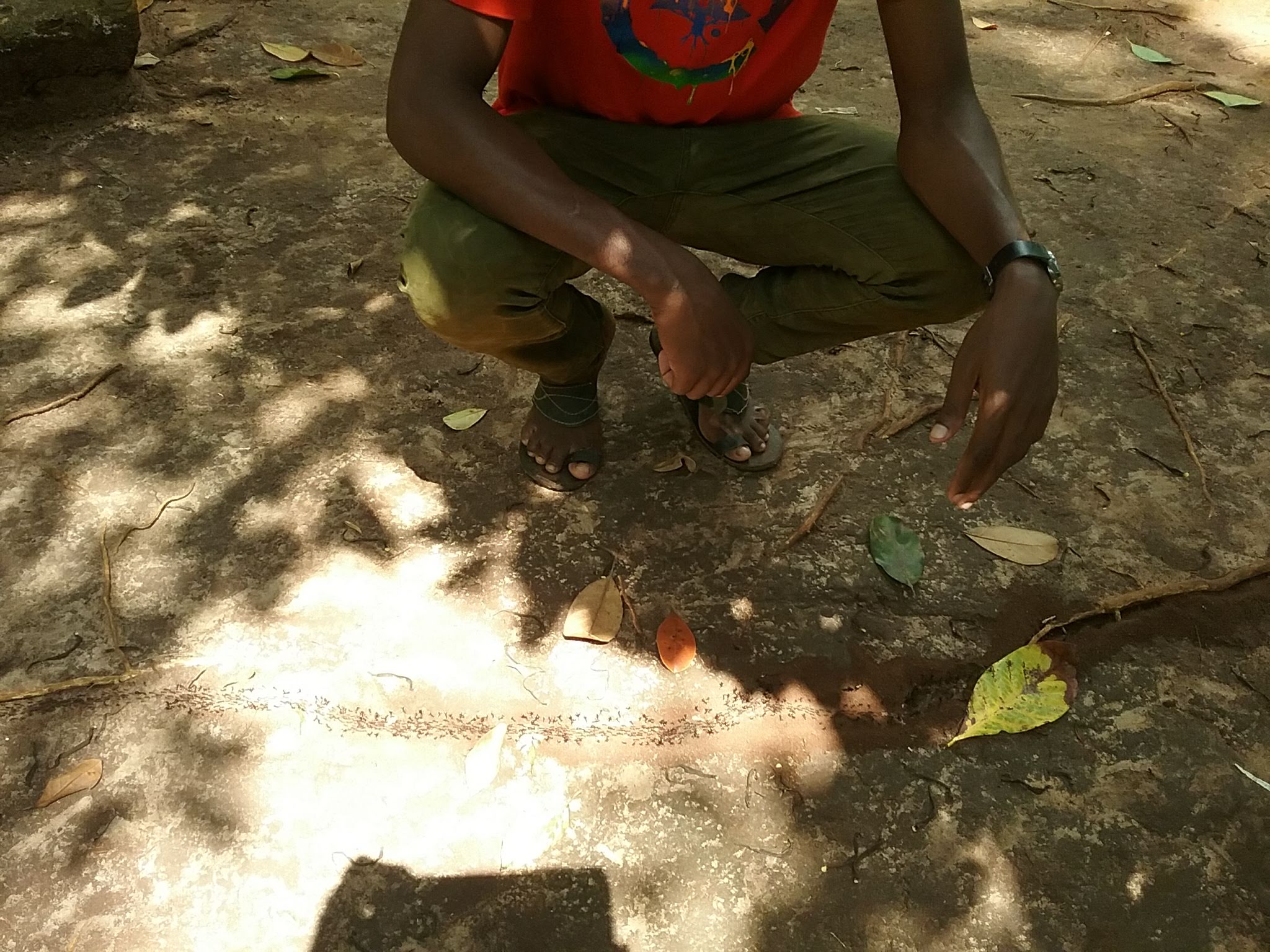
"Don't step on these," we were warned -- fire ants!


So much more that I could say about this place -- the last operating slave market in the world, for instance.  I took a tour and it opened my eyes to a lot, a lot that I had never heard in the U.S.

By the way, we're not the the only country that had election year strife.  They had an election here in Tanzania/Zanzibar last Tues., Oct. 27.  Authorities were expecting demonstrations, even riots; soldiers in red berets and carrying AK rifles were patrolling  the streets.

Tourists were rounded up, ordered into their hotels.  We were hunkered there the entire day with doors closed.  From a terrace restaurant three stories up, we watched tense situations build and then dissipate in the square down below. 

Reports are that people were shot at the north end of the island; others worked over with clubs here and there.  In the wake of this, to prevent demonstrators further organizing, the government pulled the plug on the Internet.  So that was the last real news the rest of my time there.   


My hotel -- doors were shut up and locked election day, all guests inside.


Maybe you've heard of the movie "The Year Of Living Dangerously".  Well, that was the Day Of Living Dangerously.  The next morning, like someone flicked a giant switch, things pretty much were back to normal.

(It reminded me of being in Bangkok some years ago during a coup, when the government there came under siege.  But that, as they say, is another story.)


Beach at Paje, on the east coast of Zanzibar.


More of Paje beach, Indian Ocean in the background.


Stone Town harbor at dusk.


At any rate, so much for Zanzibar Island.  On to the interior of Tanzania now to meet the famous Maasai tribe and view the tallest mountain in Africa -- Mt. Kilimanjaro.  And hopefully to view some of the wildlife so renowned in that part of Africa.


Next stop, safari country.


Covid Update:  "No Covid on the island, boss.  No Covid," as one taxi driver put it.  Whether accurate or not, it's a typical response when I inquire of locals on the subject.  I would say, after a week here, the virus just isn't of concern on Zanzibar.  At least not at present.

Following is the flag of Tanzania/Zanzibar; they're both kind of, more or less, the same country.  I love the colors...


END


Sunday, October 13, 2019

The Golden City Of The Desert


The fortress castle at Jaisalmer


It's almost midnight and I am on a rooftop patio high within the fortress walls of the city of Jaisalmer.  Also known as the golden city because of the amber-colored sandstone quarried for its construction.

The Thar desert of western India, flat as a cricket field, stretches off from this hilltop fortification in all directions. To the west, maybe 100 km. away, beyond the twinkling lights of villages and rotating wind turbines, lies the border with Pakistan.

Tonight I am recuperating within these ancient battlements and blocked-up walls. The journey here has been excruciating, to say the least.  Thirty minutes earlier, weary from the long ride, I had staggered off a bus and dragged myself up this considerable hill.  After passing through the castle gate, I puffed my way on to a guesthouse situated about as high as you can get in these parts.


Typical street scene, with cattle roaming freely.  Note the castle gate at right.


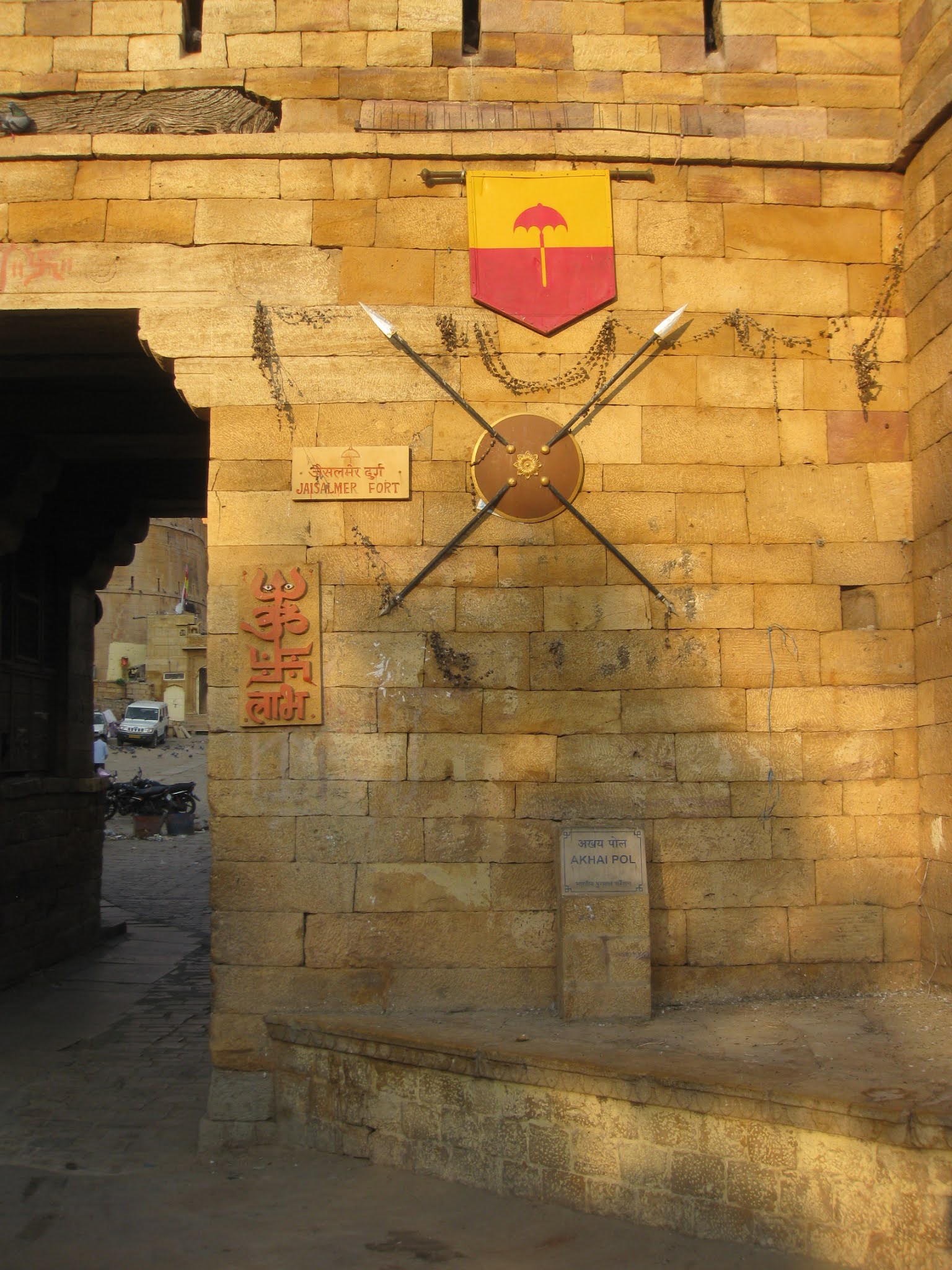
Coat of arms.


My room at Sagar guesthouse was at top left.  Great view!


Overhead beams a brilliant full moon.  Hundreds of bats flap about wildly, picking off mosquitoes and other insects.  I lay back, bask in the moonlight, and take in the spectacle.

A house boy, as they call them here, brings me a silver tray with sparkling soda water juiced up with fresh limes.  They are grown locally and are sweeter than regular ones.  He pours out the bottle and offers me the glass.  "For you, Mr. James," he says.  "For you."

Mr. James, I like that; makes me feel like one of the White Rajas.  Real special.  I may even give him a tip.  I sip at the effervescing liquid and am revived by its tartness.


The house boy sweeping up.


View from terrace at Sagar guesthouse -- Pakistan off on the horizon


Where I was in India -- Rajasthan State.


One week into India, it's been quite an experience.  As advertised, and as I'd been told, a far different culture.  Certainly different than anywhere I've ever been.  Check out the following photos for an idea why...


Ganesh the elephant god -- quite popular here.


Imagine this sign being posted in the U.S.!!!


This part of India, the Thar Desert, is camel country.


People often ask:  Traveling solo so much, how do you connect with people?  How do you intermingle with the locals, experience the culture when you don't speak the language, or not much of it anyhow?

One way, I tell them, is the same way many do in the U.S. -- go out for morning coffee.  Or in the case of India and most other countries in this part of the world -- morning tea.  You can find coffee here, yes, but tea is the main drink. 

Down from the castle where I was staying in Jaisalmer, for instance, were various "chai wallas" or tea stalls.  I visited the one shown below each morning.  Being the only white person there, I was somewhat of an exotic and quite noticeable.  Thus lots of people approached and talked with me.

Or to put it this way:  In such places rarely, if ever, have I wanted for conversation or companionship, as long as I put forth a little effort.


Where I'd go every morning for masala chai (spicey milk tea).  


  Parbhu, the owner, behind pot of simmering tea.


Chai walla in Bundi, another town I visited.


One good thing about the chai wallas -- they're in every town and burg in India.  I look for keys such as this for how to "unlock" the culture of a place and to better experience it.  Learning snippets of the language is another -- how to say hello, good morning, thank you, that kind of thing, is another.

Familiarizing oneself with tenets of their religion is yet another -- if you're not careful, sometimes you can insult people, however unintentionally.  Also respecting local dress norms.  The entire five weeks there, I don't think that I saw an Indian woman reveal so much as a bare leg -- that's how modest their style of dress. 

So I tried to respect the local culture as best I could.  As a result, for the most part anyhow, I got along there just fine.


Typical sari or dress that women wear.


END OF PART ONE


Sunday, December 16, 2018

Dal Bhat And Mo-Mos -- Nepali Eats


Selecting a goat for one of the annual feasts in Nepal.  


Flying into Nepal, I had a big question mark on my mind as to the food.  I had studied up on the place beforehand, including what people ate, but even so, couldn't quite orientate my taste buds in that direction.  The ingredients, even the names, were too exotic or something.

Dal Bhat, for instance, the signature dish of the land.  But what the heck is that?  Dal Bhat?  Here is one definition:  

Dal Bhat:  a traditional meal originating in the Indian subcontinent, popular in many areas of Nepal, Bangladesh, and India.  It centers around steamed rice or Bhat and a cooked lentil soup called Dal.  Depending on the region and the season of the year, various side dishes complement.  Often served on elegant brass or silver sets.

I didn't realize it when I stepped off that airplane, I was about to experience one of the ultimate dishes for travelers...


A typical Dal Bhat...250 Rupees ($2.15 U.S.)


From left to right on the plate:  sauteed green beans and potatoes, steamed spinach, steamed rice, and mini-French fries.  The goblets contain lentil soup on the right and goat meat in curry on the left.  At top is a large corn chip and sliced cucumber.

What this added up to is a balanced meal, something that can be hard to find in some places when you're bouncing around the back country.  Heck, it can be hard to find in the Land of Burgers and Fries, the U.S.!

But in Nepal it's seemingly everywhere, everyday...and the ingredients vary depending on the season and what's being grown in that locale.  So it doesn't get boring.  You roll into a new town and it's a mini-adventure for the palate as to what's being served up.  Meanwhile the basic formula remains the same.

All this by way of saying, three cheers for Dal Bhat!


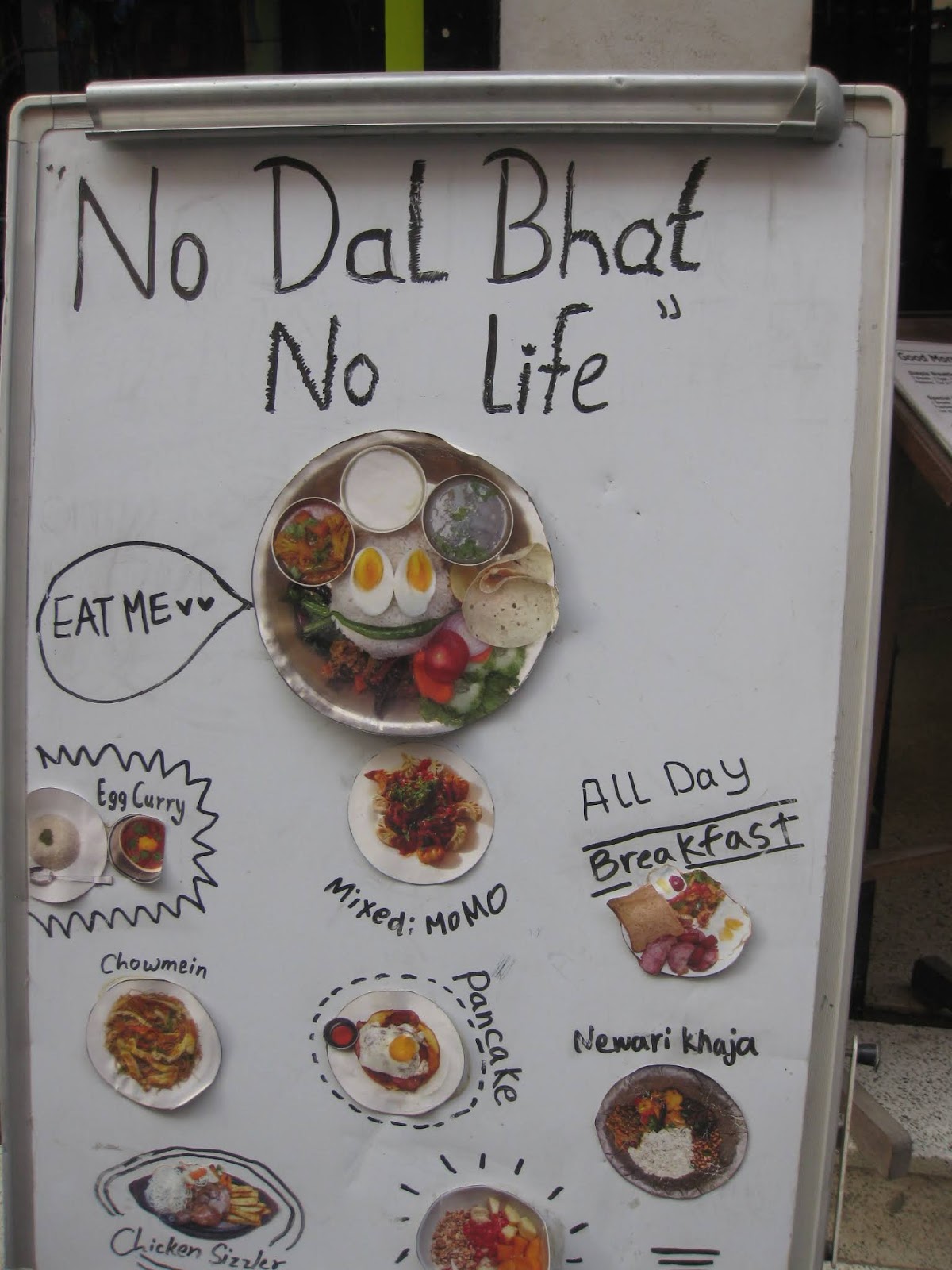
Popular saying in Nepal.


Lots of freshness at the marketplaces -- tomatoes, cauliflower, greens, etc. 


While coffee is consumed there in good measure, Nepal is generally a tea drinking country.  Most Nepalis start their day light -- a cup of masala or spicey milk tea and some kind of baked good.  Later in the morning they'll eat a hearty brunch, say at 10 or 11 in the morning.

The brunch often is in the style of Dal Bhat, only with eggs and maybe bread instead of the lentils and rice.  And it's just as good, as far as I'm concerned, and nutritious as well...


Start off with the Himalayan Times and a cup of masala tea


Later on -- a rolled-up omelet with curry vegetables and salsa-like condiment...


Or maybe go the roadhouse breakfast...this one for 200 Rupees ($1.75 U.S.), with ginger tea.


Sometime between brunch and dinner, maybe you want a snack, something small.  Give a try to some Mo-Mos.  Nepal is known for them.

They're on the order of dumplings with a filling of buffalo, chicken or vegetables, your choice.  In general I found them tasty, but rather on the greasy/oily side.  Squeeze one and you could lube up a rusty hinge with what oozes onto your palm!

So I'm glad I had them a few times, but wouldn't want them as a staple.  Nonetheless, these are one of the top restaurant offerings in Nepal...  


Typical Mo-Mos, these with chicken filling.  Note ooze on plate.


John Lennon's song, "Give Peace A Chance," could be an anthem here in Nepal.  There's so many shops, restaurants, guest houses, etc. using peace for a theme in one way or another.  Below are a few examples...


Restaurant in Bhaktaphur.  Note woodcarving, which the city is known for.


Your humble correspondent, ready for the dusty streets of Kathmandu.


Many eateries vying for vegans and vegetarians.


And let's not forget the soups.  Nepal has some of the best that I've had in Asia or anywhere for that matter.  Simple, hearty and tasty.  Here's one of the most popular...


 "Thukpa," this one with rice noodles and slices of  buffalo meat, about $1.60 U.S.

  
Having finished eating a Dal Bhat one evening, I was sitting in a restaurant in Kathmandu and gestured to the waiter to get my check.  To my surprise, he approached and asked, "Would you like to finish the meal, sir?"

Finish the meal? I wondered.  What the heck does he mean by that?  Desert or something?

He held out a set of bowls containing seeds.  In Nepalese they're called simply "sup,"  Also known widely as anise or aniseed.  He explained that you don't toss back a handful, like say with peanuts.  Rather, you take a pinch and nibble on them like a chipmunk does a morsel, savoring the flavor.  This aids in the digestion and leaves a pleasant aftertaste, with a hint of licorice.  Thus the phrasing used there, finishing the meal.


Anise or aniseeds for "finishing the meal."


Speaking of finishing things, this does it for my series of travelogues on Nepal.  As I've stated throughout, the country was difficult to get around, often dirty and dusty, the roads hellish.  But considering the culture, the food, etc., one of the most fascinating places I've ever visited.

With that in mind, and if you have the urge to go, I'd say go for it.  If nothing else, the scenery and the people were wonderful.  

Thanks to those of you who followed along through all four of these.  Happy Holidays and happy travels, wherever they may take you!


Image result for nepalese flag
Nepalese flag


[END OF SERIES ON NEPAL]


Sunday, December 9, 2018

Conversation With A Monk


Monastery Kopan


After two weeks in Nepal I found myself faced with that inevitable question -- what do you do after you've been beat up by the roads, choked by the dust and smog, deafened by the swarms of motorbikes?...

Why, check in to a Buddhist monastery, of course.  In my case it was the Kopan Center for Buddhist Study and Meditation, on a hilltop overlooking the city of Kathmandu and its urban sprawl.


Sign outside check-in.


I was shown to a dorm with ten bunks, the mattresses about as thick as a book of the Sutras, their sacred texts, and about as hard...handed a sheet and pillowcase, and shown the bathroom down the hallway.  After that I was pretty much on my own.

The cost?  $7.40 U.S. per night, which includes three meals (vegetarian) and 5 p.m. tea and socializing.  You're free to attend morning Puja (chanting and prayers) at 6 a.m., Dharma lectures at 10, and various other monk-related  activities.

Don't interfere with the monks in their day-to-day activities, I was advised.  Then pointed over toward the dining hall, where people were gathering for afternoon tea.


Entrance plaza and forum.


View from dining hall.


Decorations over Gompa (chapel) doorway.


After a few days there I came to realize, what a difference from the rest of Nepal, where most of the people are Hindus. They routinely eat meat (buffalo, goat and chicken mainly) and their culture/religion is somewhat shrill.

In contrast, Kopan is an island of Buddhism hovering above the exotic madhouse that is Kathmandu.  Instead of motorbikes blatting by, it is meatless-ness and tranquility (except for the planes roaring over from time to time from Tribhuvan International).

But sounds do echo through regularly, of course.  Monk sounds.  Chanting starts up pre-dawn and occurs at periods throughout the day, punctuated by the ringing of bells and the occasional BONG from the main Gompa or chapel.  In their introductory literature, they ask that you "talk small" while there and don't even harm an insect.  I blinked aplenty at that last one, let me tell you, not even an insect? 


Monks debating and discussing the morning lesson.


Lady monks at nearby monastery for women.  Note shaved heads.


Lady monks bundling incense sticks to sell.  


I managed a private session with a monk, a respected teacher there.  He in his sandals and burgundy robes.  Me in my New Balances and black nylon pants.  (Shoes were shed at the door.)  I had questions about monk life and he had questions about American life.  A sample of what transpired:

"About this no-killing thing, not even killing an insect," I started things off.  "What about if a mosquito is biting me?  I'm not supposed to swat it?

"Our teachings are that all living things are sacred," he explained, "and that all should be granted the sanctity of life.  Such thinking is necessary for the higher progressions."

These higher progressions refer to reincarnation and getting off the endlessly rotating wheel of life.  We can never escape this cycle, never break free, unless we progress in our thinking and in our actions.  Not killing is a way of doing that, I came to understand, not even an insect.

(As best as I could, I respected this and didn't mash a cockroach once scuttling across a floor in the dorm.  So I expect to be getting off that rotating wheel pretty soon.)


Wheel of life...Note monster putting the bite on we mortals.


Then it was his turn:  "You in America are very changeable.  A lot of newness in your culture.  A lot of new things."

"Oh yes," I responded.  "There's a new fad, a new product, a new music every month practically.  I can't even keep track of it."

"My question is, what do you have that lasts?" he wondered.  "What in your culture is old and golden?"

This took me aback and I struggled a bit to answer, not being used to such a question.  Eventually though, I ticked off a few things -- religion, the English language, the U.S.  Constitution, etc.  "To tell you the truth," I sighed, "a lot of these seem to be waning in the U.S. these days...are under assault even.  I'm not sure where we're heading with all that."


The main Gompa where our discussion took place.


I asked him why monks were so persecuted in S.E. Asia through the years -- in Cambodia where the Khmer Rouge hunted them down in the Seventies and killed them by the thousands, almost wiping them out, in Tibet where the Chinese Communists did much the same in the Fifties, and so on.  I was curious, why the viciousness toward monks?  I mean, what harm are they causing?

"It's a question of devotion then, isn't it? he shrugged.  As short as this answer was, I could appreciate it -- In five days at monastery Kopan, one thing that stood out about the monks was this quality of devotion...and it wasn't devotion to some totalitarian government.

Talk about a contrast:  I was representative of a culture that changes every fifteen minutes or so; he was representative of one that hasn't changed in centuries.

It was an interesting half hour, to say the least.


Those Buddha eyes... seeming to follow me wherever I went.


[PART FOUR TO FOLLOW NEXT WEEK]