The Golden Temple Of The Sikhs

The Golden Temple Of The Sikhs
The Golden Temple of the Sikhs, in the Punjab region of northwestern India.

The Wagah Border Crossing, one of the most contentious borders in the world. I crossed here and spent an oh-so rewarding week inside Pakistan.

Sunday, November 22, 2015

Life Quest: The Burma Road (#1 in series on Myanmar/Burma)


To begin this travelogue properly, I have to go back a ways...quite a ways, to the year 1960 along a rural road in Northeastern Penna.

Many psychologists or life coaches will tell you, influences often are sown into a person's life early on.  The person him/herself may not even realize it for decades.  Such was the case with me when, at about ten years old, I was riding with my father from Lawton, Penna., to Wyalusing along Route 706 and we happened upon a series of signs for something called Burma Shave.


Image result for burma shave


It was a famous advertising campaign of the day:  Five or six signs were spaced about a hundred yards apart and formed a jingle or rhyme.  Books and countless articles have been written about the Burma Shave ads, they've become such a part of Americana.  A few examples:


Image result for burma shave books


Image result for burma shave books


Thousands of such jingles lined the roadways of America 1925-1963.  To the best of my memory, the one along 706 went like this:


                                                  School Zone?
                                                  Take It Slow
                                                   Let The Little Shavers
                                                   Grow
                                                   BURMA SHAVE


Like I say, to the best of my memory.  What I do remember was the advertiser's punch line -- BURMA SHAVE.  Back then I didn't care much about shaving cream, but Burma, what was this Burma thing?  It set me off on a quest, of sorts; reading Burmese Days, the book by George Orwell, practically memorizing Mandalay, the famous poem by Rudyard Kipling, and so on.

The Burma Road especially used to catch my fancy.  It was built by the British through the northern highlands to connect with the Chinese and came to fame in World War II as a supply route into China, an engineering marvel of its time.


Image result for burma road


Image result for burma road
Part of the road circa 1945.


Now fast forward, ohhh, about fifty-five years, and put me at the Tachileik border crossing between northern Thailand and Myanmar/Burma (the name of the country was changed to Myanmar in 1989).

Long closed to through travel, Tachileik lies in the "Golden Triangle" region, notorious in years past for opium production, gem smuggling, roving guerrilla bands, etc.  But now more welcoming because the country is in the process of opening up after decades of isolation.

This past October then, with the proper visa and paperwork in hand, I stood poised to enter this mysterious and seldom visited area...


At the Tachileik border crossing


I'll be doing a series of posts on this through the next few weeks.  Come along with me as I lift the veil on the Shan Highlands of northeastern Myanmar and imprint my size elevens onto the famous Burma Road.


Image result for burma road


[PART TWO TO FOLLOW NEXT WEEK]


Sunday, January 11, 2015

Planes, Trains & Tuk-Tuks (#8 in series)


Slumber on the Orient Express.


(The above caption is with apologies to Agatha Christie, author of the classic Murder On The Orient Express.  Sometimes I can't help myself when it comes to echoing famous titles.)

The picture itself was taken on the train to Bangkok and it certainly wasn't an express, stopping eight or nine times in four hours.  Nevertheless it was as pleasant a trip as I've ever had and got me to thinking about the different modes of transportation, how they can make for interesting travel experiences unto themselves.

For example, on this particular day, after that train ride came a hike through the Pin Klao district of Bangkok, abustle with people and vehicles, to a passenger pier on the Chao Phraya river.  There I hopped one of the nautical "buses" knifing up- and downstream.


A river bus coming in.  Note debris in foreground.


These're are among my all-time favorites -- they're practical in that they take you north-south in Bangkok and miss the awful traffic and smog; they're scenic in that they take you past various wats or temples and other sights; and they're a good old-fashioned boat ride to boot.  You can sit back and relax as you cruise the river.

As an old Coastie (Coast Guardsman) I am in admiration of the coxswains or drivers; the way that they ease these craft up to the piers, engines revving, crewman signaling with shrill whistles, despite strong currents and debris.

All this for 15 Baht or about 40 cents U.S.  What a deal.


Inside a tuk-tuk.


Next came a ride on one of the three-wheeled taxis or tuk-tuks, as they're called.  These are not as economical as the river buses, and you have to watch the drivers as they're apt to overcharge (as I know first-hand).

However, they are convenient.  Spur-of-the-moment specials, I call them.  Just hop in and VROOOOOM! off you go, your head jerking back from the acceleration.  They don't just take you places; they're a tradition, a fun ride, for a lot of us.

At any rate, those were my connections on that day, a typical travel day in that part of the world.  In a sense, it was a tour or adventure even through one of the center-piece cities of the New Asia.


A boat roaring a canal downtown.
 

Doorman at the Oriental Hotel.

  
One of the red light districts.


This was followed by a few days of seeing the sights; both reacquainting myself with some old favorites and seeking out some new ones.  

In general, Bangkok these days is a city on the move, bursting out with energy and excitement.  It has some squalor, to be sure, but young people and vitality are everywhere.  It's become one of the crossroads of the world.  Sometimes I enjoy just walking about, taking it in.

Finally I bought a few boxes of Thai tea, got one last haircut, took in one last foot massage and pedicure (yes, I said pedicure) before -- dare I say it? -- the express van to Suvarnabhimi International Airport and the inevitable. 


My barber...who gave me a nice cut for $2 U.S.


I almost choke up as I write this, but all things must come to an end.  My grand journey this time finished up with Air China flight #980.  (Again, an interesting transport unto itself, with the stewardesses in red berets and scarfs, and roast duck served at 35,000 feet.) 

Thus my fourth trip to S.E. Asia concluded.  This was perhaps the most rigorous and taxing, but one of the most interesting as well.  It's taken me weeks and weeks to process it all, if I even have yet, a month-plus after returning.  This is one reason that I do this blog afterward, rather than while I'm traveling, as it allows me some perspective.

Suffice to say for now, it's been one helluva ride.   


[END OF SERIES]


Sunday, January 4, 2015

Veteran's Day In Thailand (#7 in series)


The Bridge on the River Kwai.


This past 11th of November, Veteran's Day, found me in the town of Kanchanaburi in western Thailand.  It's the site of one of the most famous railway crossings in the world -- the Bridge on the River Kwai, of historic and cinematic renown.  (The movie of the same name won a slew of Oscars in 1957.)

I was in the rest-up-before-I-go-back-home stage of the trip.  After banging through Lao, Cambodia and a good part of Thailand for six weeks, I was pretty well burned-out.  Thus my sojourn there for a week, in one of the most tranquil and restful spots I've ever been.

And economical...unbelievably so by U.S. standards.  I was paying 70 Baht or $2.25 U.S. for a room (of so-so quality, I admit) at the Jolly Frog Guesthouse along the river...


Your correspondent...giving the seal of approval.


My digs...Note the all important fan at left.


A great cast of characters was staying there as well.  Most of them taking a break from traveling like I was.  Camaraderie and good spirit prevailed.  When such people get talking, from all over the world. there's nothing quite like it.

And the eats weren't bad either.  A typical noodle soup or pork rice dish cost 30 Baht (95 cents U.S.).  Cashew chicken or mango with sticky rice go for a little more, but so worth it.  Massages are $5 or $6 U.S. and last for an hour-plus, and so on.

It gets hot at mid-day and the mosquitoes will eat you alive at dusk, but in general it's a great place to lay over.


The mango lady.


Her specialty -- mango with sticky rice (in warm coconut milk).


Regarding Veteran's Day, I happened upon a ceremony in the war cemetery here, containing the remains of about 7,500 veterans of World War II.  Three such cemeteries are scattered about the area -- British, Australian, and Dutch graves mainly, with a few hundred Americans thrown in.

It was all very stiff-upper-lip:  The Union Jack and other banners were unfurled and paraded about; white tropical uniforms sporting rows of medals; a bugler playing taps so hauntingly that it made my eyes water.

Veteran's Day in Thailand...it caught me unawares as I thought that it was only observed in the United States.  But here it's marked by the various nations that fought the Japanese in S.E. Asia -- The Allies, they called them.


A Thai teacher explaining how all these men died.


A veteran pays his respects.


Much moved, afterward I plucked up a flower and proceeded over to the famous bridge itself.

Used as slave laborers by the Japanese in WW II, about 16,000 Allied POWs perished making the Thai-Burma Railway, the "Death Railway" as it was called, of which this span was a part.  An estimated 80,000 Asian laborers died on the same project.  The cruelty and suffering were unbelievable, not to mention the cost in human life. 

On behalf of them and those honored dead everywhere, I loosed the flower down from the railing and paused in remembrance.  Whether back in the U.S.A. or here in S.E. Asia, may we never forget.


Sunset on the Kwai.


It was my second visit to this area.  (My first was five years ago.)   I've come to enjoy staying along the river -- so still and placid that it seems like a lake, but in reality is slowly moving.  After a while my mind almost comes to mirror it.  Soon enough, however, it was time to move on. 

I had about five days left and decided to head to Bangkok -- a big bustling city, dirty and tinged with decadence, but interesting in its own way.  In honor of the POWs who built the rail line, still in use today, this time I would go by train.

All things considered, it just seemed fitting.


[PART EIGHT TO FOLLOW NEXT WEEKEND]


Sunday, December 28, 2014

The Bats Of Battambang (#6 in series)


The bats...departing their cave.

  
Battambang is Cambodia’s second most populous city and was the type of working-class place that I was looking for.  Despite its size, it has that small-town, walk-to-everything feel.  Additionally, it boasts more statues than almost any place I've ever seen!
 
Ah yes, the Battambang statues -- every circle, every park, every plaza sports a statue or carving.  While this is hardly unique to Cambodia, here they've taken it to a new level.  Animals, mythological creatures (some in obvious sexual excitement), divinities, you name it, if someone can carve it or cast it you’ll probably find it in Battambang.

The most famous of these is on the main road and is of an ancient Khmer king holding up a magic stick used to fight off foes. 


Statue of the ancient Khmer king.


The name of both the province and the city, Battambang itself means "lost stick" or "disappearing stick" or some such thing, referring to the club wielded by the legendary king.  But to me it'll always mean "place of the flies."

Known as the rice bowl of Cambodia, Battambang is surrounded by abundant water and rich reddish soil -- and livestock and their refuse.  Accordingly, it has bustling farmer's markets as well as every type of insect, it seems, on god's green earth.

Almost my entire time there, I was slapping, swishing, cursing at some kind of pesky winged creature.  Some so tiny that I could barely even see them.  After a while, my legs looked like they had been hit with birdshot I'd been bitten so many times.   


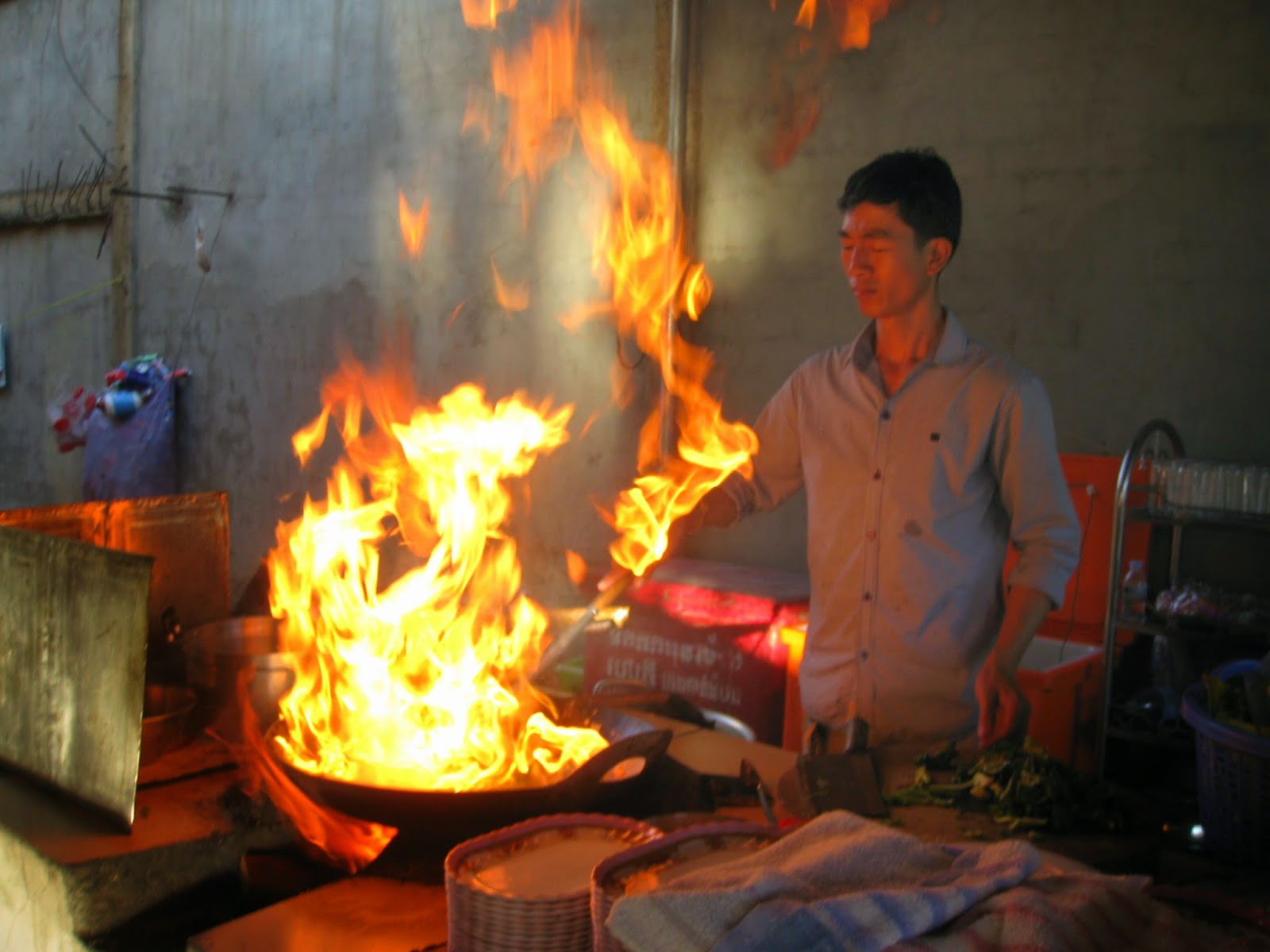
Flame-up while sautéing vegetables -- normal for this type of cooking.


The delicious result.


In one of those ironies, all the insects make possible one of Battambang's greatest attractions -- the bat caves, a short distance outside of town.

In yet another irony, a terrible one, the Khmer Rouge used some of these caves to deposit bodies during their purges during the late 1970s.  On top of a hill called Phnom Sampeau, in proximity to Buddha shrines and statues, they executed scores of people and dumped them down in.

One of the infamous killing fields, Phnom Sampeau was typical:  Doctors, lawyers, teachers, writers, monks, anyone of the intellectual, anyone even wearing glasses was rounded up by the Communists and marched out, never to return.  Altogether, about two million people were dispatched at such sites around the country.

Eventually, after the regime was deposed, the bones were retrieved from the caves here, at Phnom Sampeau, and placed in a memorial display...


From the "Killing Caves."


This was a hard one, a hard one to stomach.  Just hearing or reading about it was one thing, but seeing the remains of all those murdered people...and done in the presence of Buddha statues yet.

(Some of the skulls were small and poorly formed, I'm told, as the killing squads chucked even babies into the depths.)

Thank goodness for the bats.  They live in the same labyrinth of caves and exit at dusk by the hundreds of thousands, some say millions.  Swirling counter-clockwise, to relentless zillions of wingbeats, they snake out for hours to feed on insects.  They were a sign of life, after the remnants of so much death.


Image result for bats of battambang


Yours truly, inspecting rolling stock on the so-called bamboo line.


Like all good visitors to the area, I made my way outside of town to see the bamboo train.  The term "train" being used loosely here -- a rickety bamboo platform set atop axles and wheels; powered by an 8 hp or so engine, the type you might see on a go-cart or riding lawn mower.

(When you meet a car coming the other way, you just pick up the platform, plop it down atop the other car's axles, and away you go.)

It was used to haul freight and passengers, but is mainly a tourist thing now.  It takes you from an abandoned terminal building off through the jungle to some villages and then back, for $5 U.S.  The best part was seeing the countryside; you get a look at the way rural Cambodians live.


Claudine and Kim off for a ride.  Note engine behind them.


All things must come to an end, and this was the end of the line for me, as far as Cambodia.  Traveling through the Kingdom and Lao beforehand was rewarding in ways that I can't describe.  Sometimes it takes me weeks and months to process it all, it's so much.

But it was also rigorous travel and taxing on the mind and body.  I was making silly mistakes again and getting testy with people, as I tend to do when I get road-weary.

In short, it was time for the Land of Smiles -- Thailand.  The country and the culture (and the roads) are step up in many ways, much easier to take.  And it's such a fun place to boot.  I'd head over there and veg-out for a while.


[PART SEVEN TO FOLLOW NEXT WEEKEND]


Sunday, December 21, 2014

Coming Into The Kingdom (#5 in series)


The "ghost crossing," the Lao/Cambodian border.  Where are all the people?


Our driver had warned us -- the road down into Cambodia was "much rough."  As most of us in the van had just been through Lao, with its awful roads, this didn't arouse much concern at first.

Then we got to the international border.  Guards and customs officers were lounging in white tees, playing cards or computer games in the heat, their uniform shirts hanging up nearby.  We disembarked the vehicle, about ten of us, and looked around in wonderment.

Usually border crossings are beehives of activity.  Vehicles are backed up in both directions at the gates; buses and taxis lined up nearby, drivers trying to entice you into a fare.  Vendors hawk everything from carvings of the Buddha to rice wine.  Yet this one was practically deserted.

Soon enough, we found out why...


The "road" down into Cambodia.  


$35 U.S. for this, my tourist visa.


Minutes after clearing customs and procuring our visas, we were sliding open the side door of the van and a few of us ejecting to push us out of a mudhole!  And they kept coming, these mudholes, every so often for hours.  Meanwhile the air conditioning went out; some people got sick and had to bolt the vehicle and throw up (I wasn't one of them this time).

Well, you get the picture.  Kind of a rough ride.  Eventually we made the city of Stung Treng and a little terminal run by the transport company offering food and drink.  The city lies along the banks of the Mekong and, as much as the mound of rice topped with pork and egg, seeing the Mother of Waters again bucked me up.

As dusk fell, it was on to the city of Siem Reap and one of the great archaeological wonders of the world -- the temples of Angkor Wat.  Fortunately for all concerned, a new road there had just opened, so this leg was relatively smooth.  We were able to doze as we sped on into the night.


The main temple of Angkor Wat, with the famous five spires.


A Hindu shrine within.


Climbing up into a spire.


The largest religious monument in the world, Angkor Wat is a complex of temples and temple compounds extending for miles. It's often mentioned in the same breath with the pyramids, the Taj Mahal and the Mayan cities in Central America.  Called a masterpiece of composition and balance, it's the equivalent of a good-sized city.  In fact, the name means great templed city.  

It's so overwhelming that I decided to spring for a day tour with a group and guide, rather than undertake it on my own.  Sometimes this is the best course, I have found.

While as many as a million people lived there, a lot of it is now overgrown with vines and tree roots, populated by monkeys and squawking birds.  At some structures the building blocks have toppled into piles or are teetering with only vegetation holding them up (seemingly).  I hesitated at entering because of this, but eventually did.


Our guide -- explaining some carvings.


A courtyard in Ta Prohm, the jungle temple.


The five spires of the main temple have become a symbol of Cambodia; appearing on its national flag, the national beer, the national currency, etc.  All in all, it's the country's prime attraction for visitors.

As impressive as that may be, herein lies the problem -- the visitors themselves, lots and lots of visitors.  In fact, the city of Siem Reap, which lies about four miles away and exists as a base of support for the site, may be the biggest tourist trap I've ever seen.

I must admit though, as touristy as it was, I liked Siem Reap.  Despite all the hawkers selling tee-shirts and statues, the Seven-Elevens, which are on almost every block, the restaurants with WILKOMMEN, SAUERBRATEN glowing in orange, the place exuded character, I thought, and a touch of the exotic.


Your correspondent, at the jungle temple.


Fellow coconut lover.


Barbecued pork on rice ($2 U.S.), in Siem Reap.


For Americans, a big plus is that Cambodia uses U.S. dollars.  The national currency is something called the Riel, but in my two weeks there I barely used it.  Almost all prices are in U.S. dollars, most Cambodians prefer dollars, and some ATMs dispense solely dollars (although most offer both currencies).

This was nice as I didn't have to expend brainpower figuring exchange rates every time I went for a mango/banana smoothie (3,000 R or 75 cents).  Nor did I have to keep track of two currencies. 

I must admit, by this time in the campaign my brain was getting a little frazzled.  There's so much stimulation on these trips, so much banging around on buses, boats, etc., so many people trying to scam you that it grinds you down after a while, or at least it does me.  Especially after you've been road-sick a few times.

For this reason, I decided to cut short my time in Cambodia.  I'd do one more town in-country, explore more area.  Instead of a rollicking party zone beset by the international jet set, I'd do a working-class burg and see how the home folk lived.

It should, I concluded, be quite a contrast.


[PART SIX TO FOLLOW NEXT WEEKEND]