The Golden Temple Of The Sikhs

The Golden Temple Of The Sikhs
The Golden Temple of the Sikhs, in the Punjab region of northwestern India.

The Wagah Border Crossing, one of the most contentious borders in the world. I crossed here and spent an oh-so rewarding week inside Pakistan.

Sunday, December 7, 2014

Fireboat Festival! (#3 in series)


Wayward creature that I am, I didn't realize that travelers luck was shining upon me that first night in Luang Prabang.  The next day happened to be Oct. 9, the date of the full moon.  A fortuitous coincidence for someone just off the slow boat, as that means one thing this time of year -- Fireboat Festival!

It gave me a day to rest up and get my bearings.  And good thing that I did, because about dusk the next day the floats were rolled out and the festivities began...


Boan Lai Heua Fai as they call it here.  The motif was boats or more accurately, dragon-like boats aglow with lights, torches, candles or the like.  

Followed by scores of gas-fired lanterns wafting up into the night sky.  Followed by people setting tiny palm floats, topped with incense and candles, off upon the river.  So many that the Mekong was practically a-twinkle that evening, my friends, with candles drifting off into the distance. 

My favorite was the fire dancers.  When the parade would back up and stall, they would dance at center-street, a circle of onlookers gathered around.  Turning to each of the four directions, they ejected fire out of their mouths like a human flamethrower.  I was a good fifteen paces away, yet the heat singed my eyebrows!


Offerings for people to light and set afloat.


Even the monks turned out.


The climax was river boats, festooned as well with multi-colored lights, parading by the shore, followed by a spectacular fireworks display.

Many such events in this part of the world are "lunar" or keyed to the full moon.  This one supposedly is to celebrate the end of Buddhist Lent, when the monks end their annual three-months of study and retreat.  But it's as much about Mother Mekong herself, the life-giver for much of the area, as far as I can tell.


Launching a sky lantern.


Speaking of the monks, Luang Prabang is famed for them.  They arise before dawn and troop the streets in an olden ritual, where people present them with alms, or shall we say in this case, breakfast.

The monks then return to their "wats" or temple compounds (they must be back by sun-up) where they eat one of their two meals.  The other is at 1130.  After noon, they eat no more solid foods the rest of the day.

They can drink liquids later such as tea or juice though, and sometimes, depending on the policy of the wat, Coca-Cola.  Indeed, one day I saw cases being hauled in.  How about that?  Even the monks of Luang Prabang have a taste for the stuff!


"Tak Bet" or alms-giving.

 
Regarding this practice of giving alms, I roused myself pre-dawn and did it once myself.  A local woman had taken me under her wing.  She handed me a woven bamboo tray with clumps of sticky rice, monkey bananas (small) and bags of sugared crackers.

Don't speak to them and always give them two items, I was instructed.  So I hunched down to my knees as the first group approached and proceeded to do just that.

Soon after, I was a busy little beaver...Sticky rice, banana...sticky rice banana...sticky rice, crackers... handed out as each one filed by and presented his pot.  The way it worked, that first group came from one particular wat..the second group from another...and the third from yet a different one.

In fact, there're wats or shrines all over the place in Luang Prabang.  Practically everywhere you look.  Often referred to as a holy city, the place is changing, though.  It's as much a tourist town now.

These days, you can wash down your croissant with a cappuccino freeze at cafés.  People with big-barreled cameras and French, German or English accents swarm the night market in search of silk and souvenirs.  An extension is being added to the runway at the airport.

In spite of this, the city seems to have retained its spiritual character...at least so far.


 Sacred Ho Prabang, on the grounds of old Royal Palace.


Paying homage at a jungled shrine.


328 steps to see the Buddha--and the view--atop Phousi Hill.


One final note about my experience of alms-giving:  As I was hunched there, sticky rice at the ready, it was exciting somehow.  As these men in saffron/orange passed, close enough to touch, they brought with them a certain energy, a certain aura that I had never felt before.  It was both calm and calming, and left me with a pleasant glow within.

The monk way of life produces this, I believe.  I couldn't help but think -- back in the U.S.A., where monasteries and such are practically gone, if we haven't lost something...something intangible but valuable in its own way...a reservoir of such energy.

Anyhow, amen on that for now.   


Seal of the King, atop the old royal palace.


Over my budget at 70,000 KIP ($8.75 U.S.) per night, but I was seduced by the beautiful wood.


I was sorry to leave Luang Prabang.  It was touristy yes, but such a nice place to visit.  But I had used up almost half my time and money, and still had a long ways to go.  As I've written in here before, to accomplish travel goals sometimes you have to keep movin'. 

Another reason I was sorry to leave, next came the bus ride from hell down to Vang Vieng, when I had to grab for barf bags more than once because the switch-backs were so relentless and awful.  For seven hours through the mountains, we didn't traverse a straight stretch of more than a hundred meters.  It didn't bother some passengers, but sure did me!

As things turned out, it was worth it to spend some time farther south at the 4,000 Islands, one of the jewels of the Mekong.  More on that in my next report.


    [PART FOUR TO FOLLOW NEXT WEEKEND]


Sunday, November 30, 2014

Slow Boat To Luang Prabang (#2 in series)


Loading up to head downriver.


"Sah-bah-dee" as they say here (greetings), once again.

Lao at last.  On the 7th of Oct. I crossed the Mekong at Huay Xay, cleared the international border and picked up a traditional longboat heading downriver -- along with about 30-40 others.  Most of them were felongs or white foreigners, along with a dozen or so Lao people who sat in the enclosed back of the boat, apart from rest of us.


Mekong River longboat.


It was a daily 1100 departure carrying passengers and cargo.  The itinerary?  Two days down the Mekong...past pyramid-shaped peaks coated with green, past Matterhorn-type protrusions somehow supporting timber drooping with vines...though, for some reason, practically devoid of wildlife...to the old imperial city of Luang Prabang, in northcentral Lao.

To my disappointment, almost every animal along the way was domesticated:  a few gaggles of pot-bellied pigs; lots of water buffalo; a group or two of elephants with handlers; a few white birds of some type...Otherwise it was like a chapter out of Silent Spring.


Lots of buffalo, but where's the wildlife?


As it turned out, the most wildlife on this excursion was on the boat itself.  Most passengers were more interested in the alcohol service in the rear than anything else.

After four or five hours underway, the "partying" was reaching critical mass, and it was truly an international cast -- alcoholic Australians, inebriated Eurotrash, carousing Koreans, chortling Chinamen -- all roaring it up like pirates after a good plunder.


As the journey went on, some were hanging over the side, heaving or barfing; some dropped 640 ml BeerLaos onto the deck to dull thunks of shattered glass and suds...

And this bunch was not about to be shut-off:  With the party animals stomping their feet and banging the hull with their empties, at least four times the boat pulled over to shore.  The Lao lady who minded the bar troddled a path up from the riverbank, disappeared within a wall of green vegetation, and returned a few minutes later with a yellow case of BeerLao on her shoulder.  Party on, as they say.

(Just what was up there those times, beyond the vegetation, I don't know.)


Overnight here.  The only way in or out is by water. 


Local woman, near Pak Beng.


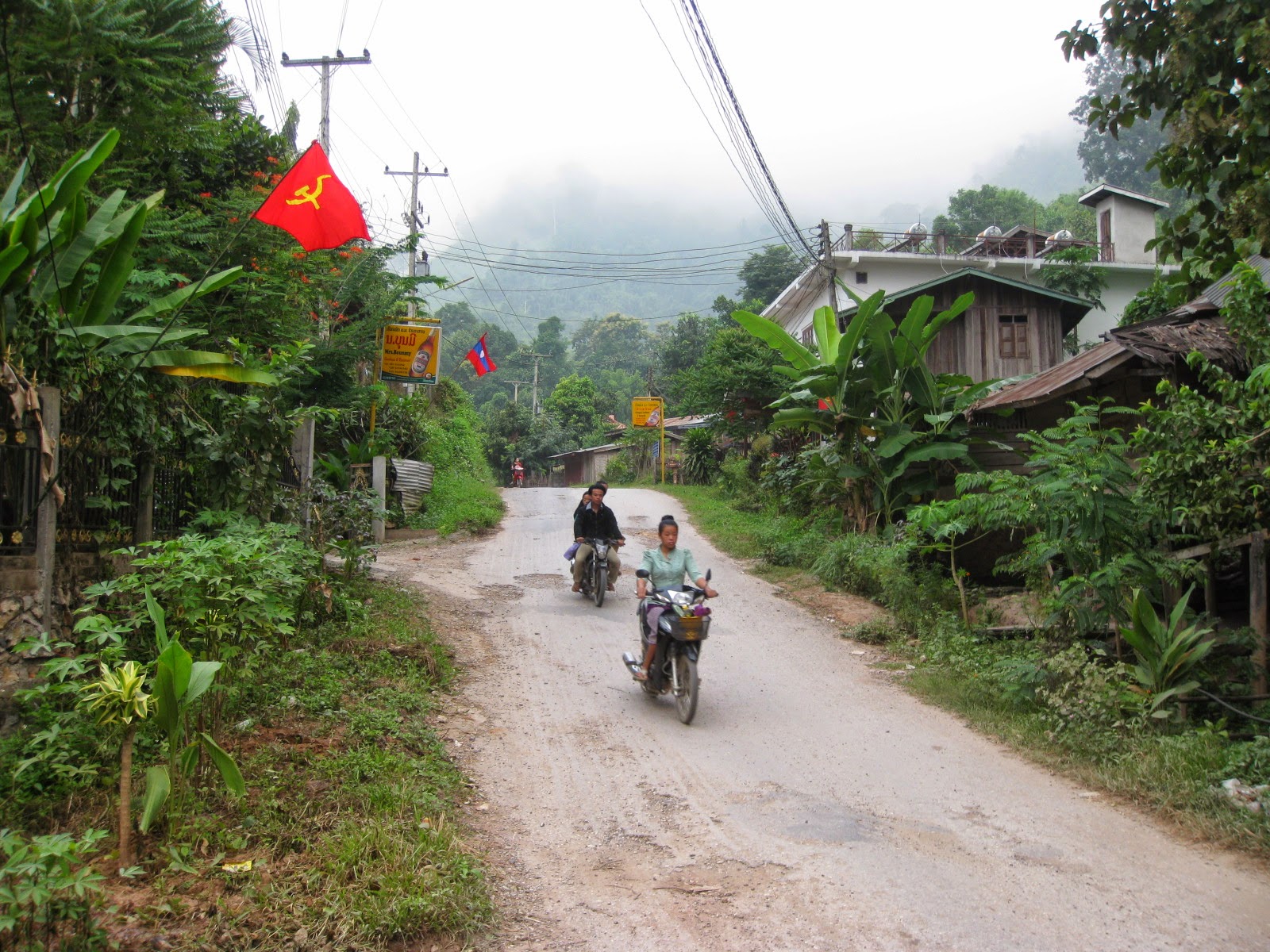
Street in Pak Beng.  Note Communist flag at top-left.


The boozers didn't have to skip a beat when we disembarked at Pak Beng, the river town where we overnighted -- a smiley little man was handing out cups of the local brew to all visitors who passed by.  Evidently the custom there.  Later at the restaurants, a complimentary shot was served along with all food orders.  Again, the custom there.

What did it taste like?  Well I can tell you this:  After my order arrived, I slid my shot across the table to a guy from South Korea.  The jaunty type, he held it up in a toast, then downed it...Shortly after, his body was spasming in revulsion, followed by coughing and gagging.

By the way, Pak Beng was the first place I ever saw water buffalo on the menu.  This is common throughout Lao, I discovered, but my first time.  (It was tough and stringy and made my jaw sore I had to chew it so much.)


What a tabletop!  At one time, big timber sprouted in these parts.


Now a few words about traveling the river itself:  First off, this was not the poke-along ride that I thought it was going to be.  The Mekong through these parts is a-movin'.  A relentless, swirling flow.  You jump in on one side and try to swim across, you better be a strong or it'll sweep you way on down, if you make it at all.

Second, the river runs wide for miles, then narrows into numerous canyons, often strewn with rock formations.  More often than not, these canyons acted like wind tunnels, perhaps even generated their own wind because before our boat entered conditions were calm. 


Some of what we had to negotiate. 


The wind, the current, the rocks -- for these reasons Mekong River boats here are long and flexible.  They're made to be maneuverable, to swerve around hazards, which can be unnerving if you're not used to it.

For example, you enter into a canyon strewn with rocks...The current picks up, you zag past whirlpools big enough to swallow a dog.  The captain is working up a sweat -- whirling the wheel left, then hard right...The boat bends and creaks and groans beneath you, flexing into each change of direction.  Sometimes you swear that the thing is going to break apart under your feet! 

Then a gust of wind impacts, trying to rotate the boat crosswise...The captain clenches teeth and rips the wheel hard some more...

This is not entirely hypothetical -- similar instances happened on the two days going downriver.  It was scary until I figured out that the boats were so-designed and could take it with ease.


Shrine on bow of longboat--invoking of safe passage.


Had trouble with this...Spent an hour marooned on a sandbar as a result.


Population-wise, the numbers in this part of the world go something like this:  Neighboring Thailand has a population of about 55 million people, while mainly rural Lao chimes in with only about 5 million.  All this by way of saying, we didn't encounter many crowds en route.  In fact, aside from a few villages, we saw very few people. 

As dusk fell on the second day out, however, that was about to change.  In the distance, glowing up into the gathering darkness, the bright lights of civilization.  Just around the bend, the city of Luang Prabang at last.  Said to be the nicest city in Lao.
  
As it so happened, more by dumb luck than anything, the timing of our arrival was superb.


[PART THREE TO FOLLOW NEXT WEEKEND]


Sunday, November 23, 2014

Drums Along The Mekong (#1 in Lao/Cambodia travel series)


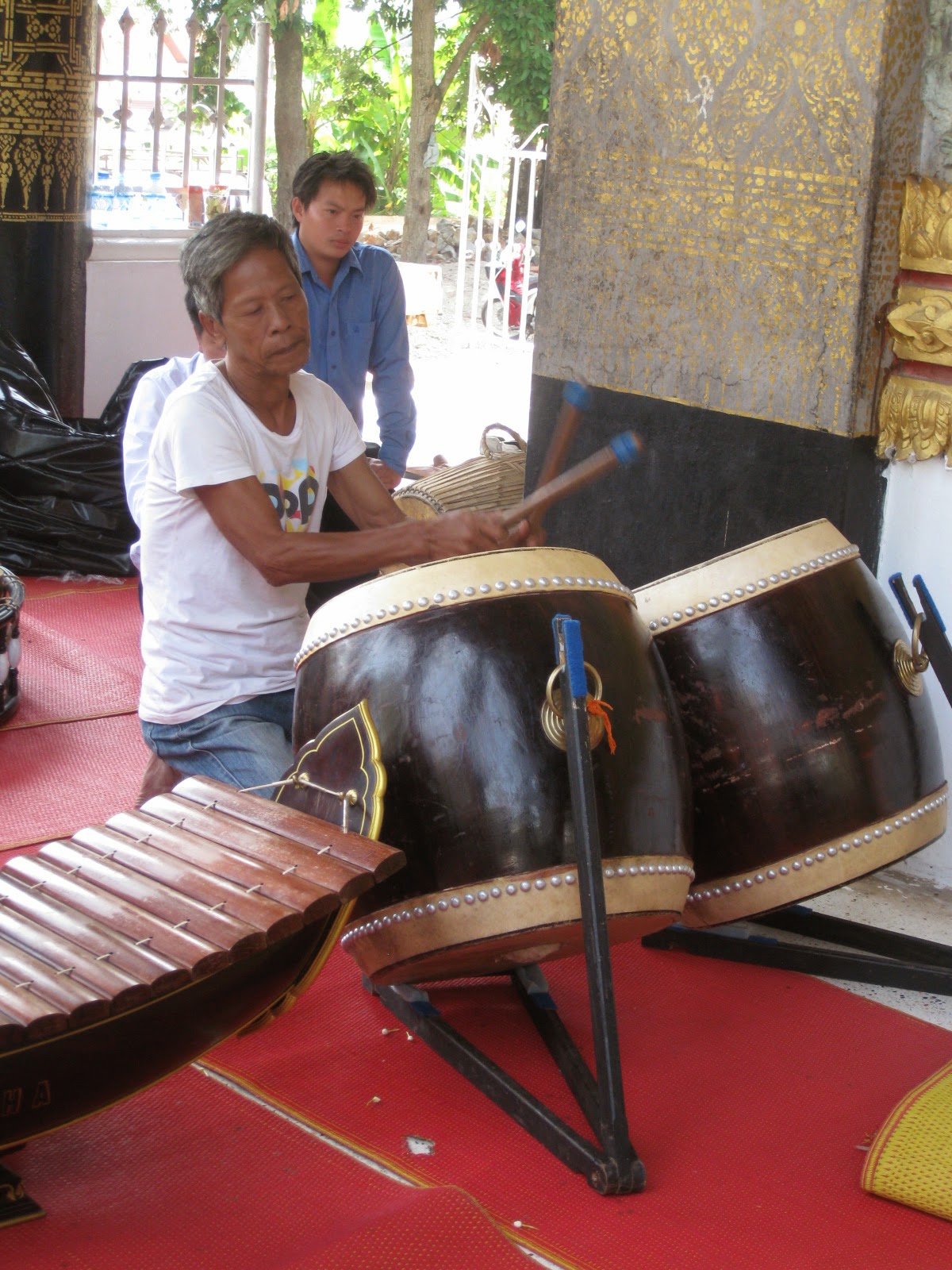
Traditional drumming in Lao.


Well, here I am, Southeast Asia once again.  My fourth time.  I landed in Bangkok Sept. 24 and proceeded north by bus to the famous Golden Triangle region.  Where northern Thailand, Laos and Myanmar (formerly known as Burma) all come together.

In decades past, the area produced a lot of poppies for opium, much of which eventually found its way into the veins of junkies in the Industrialized Nations.  For this reason the area has been portrayed luridly in Hollywood films, with dark plots and lots of blood-spattered savagery.

However, it's turned out to be one my favorite parts of Thailand.  The opium is mostly gone now, though a fair amount of locals still smoke the stuff.

Going north out of Chang Mai, the second largest city in Thailand and a favorite of tourists, you pass through valleys lined with stately green-clad mountains, past butterfly enclosures (for making silk), elephant corrals, snake and fish farms, and fields of corn, lots of corn.  Topography-wise, it reminds me of the Shenandoah Valley of Virginia. 


Your humble correspondent, in the back of the bus.
  

Rice fields along the way.


The scenery was great, especially when the bus topped out on hills clad with jungle, trees and hanging vines, but was it hot.  So hot that sometimes the sap seemed to boil right out of me.  Most locals sought shade in the afternoon and took naps, then re-emerged after sunset to shop, eat out or whatever.

Eventually I made it to Chiang Khong, a little border town along the Mekong River...as far as you can go in Thailand.  It's sunset now and across the way, across the brown and swirly flow, drums are beating out time to tribal chanting.  Probably the Hmong People, I'm told, who inhabit that part of Lao. They say that it's a different world over there, a different culture anyhow, and from where I stand this tranquil evening it certainly sounds it.


The riverfront at Chiang Khong.


Chiang Khong itself is the consummate border town -- a little rough around the edges but emanating an air of excitement and anticipation.  Vehicles are spattered with mud or coated with reddish dirt.  Many of the people are Thai, but many also are hill tribe, with crinkled, prune-like faces and brownish teeth from chewing betal nuts and various roots and herbs.  

Into this mix, toss the few odd "felongs," which is what they call white foreigners or tourists, and you get an idea of Chiang Khong -- Boggie in a ball cap mingling with friendly natives in need of dental work.  I found a nice place to stay and settled in for a few days.


 A hill woman displaying her produce.


Maleewan, the Thai woman who manages the guest house I'm staying at, describes her job:  "This is my mission -- to feed and house felongs.  So they will not be hungry on the way to Lao."

Indeed, that's what she and her staff do -- their guesthouse is a way-station, a last stop going into the so-called People's Democratic Republic.   In reality, Lao is Communist-run and has been since the fall of Saigon in 1975.  Hardly a real Republic.

Loudspeakers across the river demonstrate this every morning:  At 0500 they blare forth with rousing music and Commie-style propaganda, urging Laotians to rise up and go forth to labor for the betterment of the state, or some such thing.  Kind of a comrade-worker alarm clock. 

A lot of us at the guesthouse found this amusing -- except that the exhortations jolted us awake at 5 A.M., too.  From all the way across the river!


The dining area at Baan Rimtaling Guesthouse.
 

Maleewan, of Baan Rimtaling.


By the way, a bunk in the dorm there goes for 100 Baht these days (about $3 U.S.).  It's a little on the rough side, but the view of the Mekong is excellent and the house green curry is to die for.  It's reasonably priced as well, as is the whole menu. 


At 32 Baht to the dollar, you can figure it.


I was quite taken with Baan Rimtaling; the ambiance, the people staying there, the view of the river, etc., and would like to have lingered there longer.  But I was on a mission, of sorts, to proceed downriver through three countries:  Thailand, Lao and Cambodia.  To accomplish such things, I've learned, sometimes you have to keep movin'.

As the drums beat on across the Mekong, Maleewan admonishes her cats: "Hey, you behave or I take you all to Lao."  As for what they do with them over there, well, let's just say that most aren't kept as pets -- for long.

To explore these and other such rumors, in a day or so I head on over there myself.  Will have details in my next report.


Lao across the river.


[PART TWO TO FOLLOW NEXT WEEKEND]


Sunday, March 2, 2014

Cocibolca (#3 in river series)


Preparing to get underway.


Aboard the good ship Gustavo Orozco, about to shove off on its regular Friday run north, all hands were in a festive mood.  

Passengers who had been strangers lugging backpacks on minutes before were chatting each other up like old friends.  Captain and crew flitted around us like social butterflies.  It was like the commencement of an ocean voyage, and in a sense it was just that.

With departure at 1700 from San Carlos, it would be thirteen hours across the lake to Granada, with a stop at Ometepe Island for passengers and cargo.  An all-night steam through what was essentially a small, inland sea.


Known as the Mother Lake of Nicaragua, it is the most revered place in the entire country.  Early inhabitants of the area called it Cocibolca, which means roughly clear waters, good waters.  The Spanish referred to it El Mar Dulce, The Sweet Sea.

The largest lake in Central America, at a hundred miles across, the water is anything but clear or sweet now.  Urban sewage and agricultural run-off have taken their tolls, and the color is more brownish with an acrid odor than clear. 

Nonetheless, it's a huge expanse of fresh water, and provides host for a variety of wildlife and fish , including tarpon, sawfish, and sharks...yes, sharks.

Bull sharks have been proven to exist in salt or in fresh water worldwide.  In this case, they migrate in and out of the lake using the Rio San Juan.  Coming in from the Caribbean, they've been observed jumping the rapids at El Castillo almost like salmon. 

As stunning as it may be on a sunny day, with sparkling surface and imposing volcanic islands, Cocibolca is not always a gentle giant.  It has a reputation for lashing winds and powerful, even violent storms, whipping up almost out of nowhere...something that we were about to find out.


Good-bye to San Carlos.


Calm conditions as we make for open water.


A type of segregation was practiced aboard the Orozco.  Foreigners, or tourists, pay nine dollars U.S. for the passage and ride up on the second deck.  Locals, or Nicaraguans, pay less and go to the first deck.  This is designed, I think, to give the Nicas a break financially.

However, the way that it plays out -- fewer people are up topside, so you can spread yourself out and it's more comfortable.  But being higher up, the motion of the boat is worse up there, too.  Often much worse.  In other words, when heavy weather strikes, the second deck is not the place to be.

We found this out about four hours into the voyage:  Instead of hatches being closed with a clang and latched, suddenly they were slammed by fierce winds.  People were stumbling across the aisles or sprawling outright across bench seats due violent actions of the boat.  

I looked out to see us battered by angry waves, the tops churned white by the winds.  My god, I thought, it's like the North Atlantic. 

As the night wore on, we picked spots on the cushioned benches to lay out and did our best to sleep.  But the constant pounding on the hull and creaking and crashing about the boat made it difficult.  I laid out with my head below a window, only to have smelly water dripping down onto my face.  Splash was flying up all the way to the second deck, then leaking past the rubber liner! 

The only passengers on their feet were the ones bolting for the marine heads, faces pale, palms cupped in front of the mouths.  So much for the festive mood of earlier. 


The wharf at Ometepe -- in calmer conditions.


Near midnight, the stopover at Ometepe Island provided a welcome respite.  Waves were still impacting ship and shore, but at least we were tied up now, not ploughing through them.  The captain had swung us into the concrete pier nicely enough -- quite a feat considering the howling conditions.  However, still reacting to the extreme motions of the boat, hardly anyone got up.

Eventually I managed to my knees, to peer out the window -- and see one of the strangest sights of all my travels: 

Dockworkers were tromping the gangway; hunched forward, bunches of bananas across their backs.  Bathed in moonlight, showers of spray exploding about them, they were like worker ants stocking up a colony.  A volcanic mountain, easily visible in the full moon, loomed in the distance, and added to the eeriness of the scene.

After about an hour, we chugged back out -- and into the ongoing tempest.


Banana boat -- at the wharf in Granada, finally.


Like some kind of swarmy cosmic joke, we made Granada approximately as the wind died down.  Those of us who had been up topside staggered off and practically threw ourselves onto good ol' Mother Earth.  The Nicas, who rode it out closer to the boat's center, had a better time of it.  Most of them walked off gabbing and with a spring in their steps.

Oh well.  You'll have this once in a while, I've found, seeing the world -- a rough patch now and then.

So we wobbled off into the gray dawn, toward the steeples of Granada, a wonderful colonial-style city in its own right.  However, as good as the food is there, and inexpensive, I doubted that I'd be eating any for a while.


The square in Granada.  Carriage ride, anyone?


The End


Sunday, February 23, 2014

Of Chinese Canals And Spanish Treasure (#2 in river series)


For those of us who like to travel on rivers, San Carlos is a sort of a double bonus.  Maybe even a trifecta.

It's situated where one river, the Rio Frio, empties into Lake Nicaragua, and where a larger one, the Rio San Juan, empties out and winds all the way to the Caribbean, some hundred-and-twenty miles distant.

For those of us who like history as well -- the place is awash; in fact, it fairly laps at the shores.  Some peoples of note who passed this way:
  • The earliest Americans, who settled there thousands of years ago.
  • The Spanish, who sailed upriver from the Caribbean, crossed the lake and established a city, Granada, on the northern shore.  
  • The Buccaneers, who later sailed up the same river to rob and rape said city. 
  • The English, who came to lay siege to a Spanish fortress along the way.
  • And more, much more.
Wow, talk about a past!  After a few hours exploring San Carlos, as boisterous and busy of a river town as I've ever seen, I heeded the call and headed down the San Juan.


Loading up to head downriver.


Hutch along the way.


A half-mile wide in some places, I discovered that the San Juan is both substantial and interesting to boot.  For we river explorers, a real bonanza.

Nowhere is that more evident than downriver at El Castillo or "the castle."  Named after the Spanish-built fortification that presides over the area, it is perhaps the consummate river town because no roads lead into the place; it's come by river or perhaps drop in by parachute, or else forget it.


El Castillo


Completed in 1675, La Fortaleza, as the fortress itself called, was placed there to stop pirates and other enemies from proceeding upriver to cross the lake and raid Granada, which had become a repository of Spanish treasure.

La Fortaleza sets atop a hill overlooking a stretch with rapids -- a seemingly strategic location.  Any boats approaching could be raked with cannon fire.  In addition, the waterway was then infested with crocodiles and sharks, which migrated upriver from the Caribbean en route to Lake Nicaragua.  It made for a dangerous place to have to take a swim.

Despite all this, the fort was conquered by successive waves of raiders, and the riches of Granada plundered again and again.

Nevertheless, give the Spanish their due -- it took a Herculean effort to build it out of that wilderness, and even centuries later it's still an impressive structure to tour.


La Fortaleza


Street in El Castillo.


Seen about town.


You can tell a lot about a place by just walking around, I've found.  Or as Yogi Berra used to say, You can observe a lot about people just by watchin 'em.

El Castillo is the residents going through the morning ritual of sweeping the sidewalks with bundles of straw lashed to sticks.  It is a pig, squealing for dear life, being dragged through by a rope...a woman doing your laundry in the river for $2 U.S., and then hanging it out over bushes and banana leafs to dry.


Woman doing laundry in the San Juan.


It's a mounted vaquero or cowboy romping alongside cattle across-river...or sitting on the porch of the Hotel Victoria watching the flow in the moonlight and listening to a chorus of frogs rise to a crescendo, then fall off -- over and over again.

It's the white linen napkins at the Victoria house...where the whole grain bread comes hot out of the oven and is served with scrambled eggs and tart blocks of cheese...and where the mango juice is served in stem glassware and a single room goes for $16 U.S. per night.

In case you're wondering, in this part of the jungle that 16 U.S. gets you wood paneling, air-conditioning and your own bath.  

Usually I stay at hostels for half that price, for a bunk in a dorm room.  As my father used to say, I was the last of the big-time spenders.  But for those couple of nights in El Castillo, I indulged.  (I don't know.  It just seemed right.)


Your humble correspondent in the lap of luxury.


Magdalena, manager of Hotel Victoria.


Main means of transport here.


Downriver from El Castillo, more history -- the skeletons of paddle wheelers lie in the undergrowth; beams rotting away, their boilers and piping encrusted with rust -- relics from that great American entrepreneur Cornelius Vanderbilt.

Back in the 1800s, he set up a system to ferry 49ers from the Caribbean to the Pacific, and then on to the gold fields of California. This very river, as well as those paddle wheelers, were part of it.
 
Which brings us to present day and possible history in the making:  Our old friends the Chinese want to build a canal through Nicaragua, a rival to the famous one through Panama.  One proposed route would use the San Juan, like Vanderbilt did, cross Lake Nicaragua, and proceed to the Pacific from there.

Another proposal, the most favored one, would use a river farther up north.  As of yet, it's undecided, as far as I can tell.  But supposedly a deal was struck and construction is to start in December.

We shall see.


Could massive freighters someday loom in out of these mists?


Red Hibiscus


At any rate, far too soon, it was time to move on.  I had a date, shall we say, with another body of water, alluring in its own right -- Lake Nicaragua.

I had decided to head back upriver to San Carlos and go for an all-nighter across the lake.  Little did I know what lie in store.  Even for an old Coastie, supposedly accustomed to such things, it turned out to be one helluva time.


Last look at El Castillo -- where even the dogs were friendly.


[Part Three to follow, next Sunday, March 2]