The Golden Temple Of The Sikhs

The Golden Temple Of The Sikhs
The Golden Temple of the Sikhs, in the Punjab region of northwestern India.

The Wagah Border Crossing, one of the most contentious borders in the world. I crossed here and spent an oh-so rewarding week inside Pakistan.

Monday, November 11, 2013

In Search Of Panama Hats, Part II


Cuenca, Ecuador -- some 8,400 ft. in the Andes


Winding down out of the high passes in the bus, looking out over the city, I was struck first off by all the domes, shiny in the crisp, mountain air.  Cuenca is a city of churches, as it turned out -- dozens of them.  They seemed to be everywhere, including the central plaza area, which boasted not one but two cathedrals.


The "Old Cathedral"


Down, down our bus descended, until we entered the city proper...with the cobblestone streets, the four rivers winding through, balconies fronted with ironwork, beautiful courtyards with tended gardens withinI became a fan of the place before I even checked into the hostel!  The Spanish influence seemed to be everywhere.  No wonder that the city has been declared a World Cultural Heritage Site.

However, I wasn't able to connect with the inhabitants as well as I had in other countries in Latin America.  Many Ecuadorians were descendants of the Incas and other early immigrants to the Andes, with a culture much more stoic and conservative than, say, neighboring Colombia.  Often I couldn't break through to them, especially out in the countryside, as much as I tried.

Nor could I speak with them that well in Spanish.  It seems that the accent or style I learned in Central America did not communicate briskly there.  Because this was disappointing, and sometimes exasperating, I decided to concentrate on something else...to wit, my unofficial "mission" there, getting to the bottom of those Panama hats.  


Hot on the trail.


As it turned out, Cuenca and its suburbs are the hat capital of Ecuador.  You can this see just walking around -- colorful murals and logos adorned walls, walkways and store fronts.  Indeed, los sombreros de paja toquilla, as they often call them here (hats of toquilla palm) are practically a symbol for the area.

And it's not just a male thing, by the way.  To the contrary, women favor the famous headware more than the men.  Many even make their own.  Amazingly, using special treatments for longevity of the palm fibers, some keep them for decades, even their entire adult lives.


An Indian woman, in Sunday finest.


Now, of course, even seekers of truth get hungry.  As many of you know, I make it a habit of sampling unusual or even exotic foods in the countries I visit.  I consider it part of the cultural experience; how you really get your money's worth from traveling.  And Ecuador was no exception.


Barbecuing cuy -- pronounced "coo-eee"


Now, exactly what is this cuy? you might be wondering...  

In a real culinary twist, compared to the United States anyhow, guinea pigs have been used for food here since the time of the Incas.  And probably even before that because the Incas weren't in Ecuador that long (arriving shortly before the Spaniards).  I doubt that much has changed in that time as far as preparing them.


If you want real fresh, just pick one out and the woman will reach into the cage, grab one by the scruff of the neck and...well, you get the idea.  The next thing you know, yours is being rotated on a stake over white, hot coals of carbón wood.

As for the result, it tastes like chicken, or squirrel, or something.  Nothing exceptional, if you didn't know what it was.  Rounding out the exotic foods list for this trip, I also had piranha (supposedly) down in the Upper Amazon, but that's another story.  Back to the search for the sombreros.

While hat sellers abound in Cuenca itself, and a few hat makers as well, eventually I found that the wholesale production was done in the outlying pueblos.  Little towns such as Biblián, and especially Sigsig, emerged as more like the real sources.

So it was back to the bus station, terminal terrestre, to use the Spanish, for a trip farther up into the mountains


The central plaza in Sigsig.

 
While Cuenca is sprawled out over elevations of eight-thousand-some feet, Sigsig is even higher. And I was huffing and puffing on my walks as it was.  The height affected me so much that, those first days in Cuenca, I was light-headed, tired, and had to take naps every few hours.

In time I had adapted to Cuenca's elevation, but when I got off the bus in Sigsig I knew that I'd be woozy yet again.  But no matter -- the quest had to go on; it could not be denied.  In fact, it put a spring in my step when I heard that they fashion Habana Clásicas up there while standing on street corners.  On street corners!  Can you imagine?


In Sigsig, they do make them on street corners...


...and in co-ops and homes and little shops...


Townswomen wear them to community gatherings.


Sigsig seemed to have it all, as far as the hats go.  And it was a pleasant, little place to boot, unfettered of souvenir stands and chain restaurants, situated between two lofty peaks.

Mainly though, I thought that I was finally there; the birthplace of the style icon itself, the place where Panamas came into being.

Then, disappointment again...I was told that, no, actually it didn't begin in Sigsig or Biblián or even in Cuenca.  Rather, hat-making migrated to this region from a little town called Montecristi, near the Pacific coast.  Flat-Landerville, as we call such places back in PA.  La Costa, as they call it here.

Hat production had been shunted away from there decades ago, I learned, to take advantage of the numbers of skilled weavers in the highlands.  Nowadays, the Cuenca area produces the most by far, but Montecristi still has the best, the superfinos.  Moreover, it's where it all began. 

As you can imagine, what choice did I have?  After three weeks up in thin air country, I was tired of the mountains anyhow.  A few days later, I returned to terminal terrestre in Cuenca and caught a slow bus for the coast.


[Part Three to follow, next Monday, Nov. 18]


Monday, November 4, 2013

In Search Of Panama Hats, Part I


Tracks To Panama


Located towards the Caribbean coast, this combo railroad/walking/driving bridge marks the northern border of Panama.  Called the Sixaola crossing, from Costa Rica to Panama, it's one of the more unusual borders I've ever seen.

Making my way across a few years ago, dragging my trusty duffel behind, I had to squeeze against the railing as a hulking bus crept by a foot or so away.  The structure is so rickety, some places you can look between the planks and see brown water swirling below.  Smiley people pop out seemingly from nowhere to offer plastic bags swelled with coconut juice or hand-carved wooden necklaces.    

Passing over the first time, fairly dripping from the humidity, I peered out through the wavey heat with anticipation -- I thought that I'd get to the other side and find Panama hats hanging about on trees, they'd be so plentiful.  In these I had long had an interest and looked forward to getting one of the real thing.  What a souvenir to show 'em back home!

Was I in for a surprise.  Not only didn't I find any, except for "knock-offs" or so-so imitations, I discovered that I wasn't even looking in the correct country.  Like an international woman of mystery, the hats were a lady with a past.  And like so many things Panama, I discovered, it has to do with the Canal. 
                                        

El Canal De Panamá


It took time, but I learned that the hats originated in Ecuador, a country along the Pacific coast of South America.  (Panama is in Central America.)  In fact, the hats were developed in Ecuador centuries ago.  The palm to make them is grown only in two provinces along the coast, and the hats, the genuine articles, were woven there and still are.

Because Ecuador is an out-of-the-way country, with no major routes passing through and no place to market their wares to the world at large, hat merchants shipped them to the isthmus of Panama in the 1800s. 


There, the 49ers were passing through in droves en route to California.  There, later on, the French and then the Americans and others arrived en mass to make the Canal.  The wide-brimmed hats proved perfect to protect the workers from the blazing sun and were pretty spiffy to boot.  Accordingly, they sold by the thousands.

And there, the hats eventually underwent a transition, of sorts, at least in the eyes of the public -- from practical headgear for the tropics to fashion statement.

As often happens, a President of the United States might have set off the trend.  On an inspection tour of the Canal in 1904, Teddy Roosevelt snatched one up and soon after was photographed on a steam shovel.  The image appeared on the front pages of newspapers around the globe.  As he might have said about all this:  "Bully!"


TR at the Canal in 1904.


With his hat back in the U.S. later on.


In subsequent decades, everyone from movie stars to gangsters was sporting one and they became symbols of wealth and elegance.  Because the country of Panama was the prime selling point, they became forever etched into the collective consciousness as Panama hats.  Poor little Ecuador got lost in the fray.

Such misnomers are not unusual, of course; they appear throughout history:  The Holy Roman Empire, for instance, was not holy, was not Roman and was not an empire.  The Bridge On The River Kwai in Thailand, of book and movie fame, did not span the River Kwai, and the Canary Islands off Spain are named after dogs, not the little, yellow tweeters.  And so on and so forth.

Most people, you understand, would just let this hat thing go.  They'd buy a knock-off, sip a cool drink with a little umbrella inserted, watch the ships pass by, and go on with life.  As I said, most people. 

However, me being what I am, I was determined to get to the Source.  Oh, it had to wait a few years, until this September as a matter of fact, when I finally got to make a visit to Ecuador.


[Part Two Follows, next Monday, Nov. 11]


Thursday, March 28, 2013

Lord of Panamá, Good Morning! (transiting the Panama Canal)


The Canal from the Balboa Yacht Club, on the Pacific side.


 For The Information Of All Hands:

It's taken a couple of weeks rooting around down here in the Canal Zone to hook up, but I finally have gotten my ride.  Tomorrow morning, 1000 hrs. approx., I will be boarding the McPelican, a 42-foot sailing yacht of Australian registry, and will be transiting the Panama Canal.  It'll take two days in all to get through, I'm told, and we'll moor somewhere along Lake Gatún for the night, about halfway through.

I'll be singing for my supper on this one, so to speak, as I'll be working on board as a line-handler.  Each boat or yacht passing through needs a pilot and four line-handlers, one on each "quarter" (or two on each side) as per Canal Authority regs.

The bigger ships, including those called Panama-max as they are the maximum size that can fit into the locks, use a different system involving what they call "mules" (electric locomotives) for positioning and securing within the locks.  But the smaller ones, such as ours, still use good ol' fashioned hand power.

At any rate, this is all very exciting and the event will be duly recorded with pics and maybe some videos, so stay tuned.

Hasta Luego to you all from this, the most famous shortcut in the world.


Yours,

"Panama Jim"


   -- email that I sent out to various people Feb. 13 of this year, a Wednesday.  

The next day, Valentine's Day, I banged in a taxi over a pot-holed road winding through jungle and palms, up to the remnants of a U.S. Army base, Fort Sherman.  Most of its buildings had been stripped by scavengers -- an eerie ride-through, right out of the Twilight Zone, as generally only concrete hulks with roofs remain.  It was though a great civilization had been there and left.

We cleared through a check station manned by Panamanian soldiers in digitized camo and with automatic rifles, eventually arriving at Shelter Bay Marina, along the steamy Caribbean Coast.  After a brief search in blinding sunshine through the maze of slips, I found my boat -- the McPelican


That's Paul, captain and co-owner, on deck.  Note the tire bumpers along the side for "rafting up"with other yachts to go through locks.


Underway toward the canal entrance, Caribbean side.  These ships are anchored, waiting to "transit" -- sometimes for a week or even two!


About to "raft up" with Shellback out of Long Beach, CA.  Two or three yachts tie up into one unit and go through the locks together.


Rafted up to Shellback and a third yacht (out of sight) we creep into the Gatún locks.  Note lock door, weighing 650 tons, at right.
                                                            

It was trickier than I thought, especially when the locks flooded in with water.  It comes rushing out of huge pipes and causes a roiling, swirling current which snaps the lines taut and wants to twirl boats against the concrete walls.  This happens as warning bells clang, horns blare, seagulls and other birds flap about, and pilots and lock workers yell orders sometimes in two different languages.

Fortunately, Dillon and Sietst, two of the other line-handlers, had been through it all many times and showed me the ropes.  Bernadette, one of the owners of the boat, was a nerve-case the whole time.  McPelican was quite an investment for them and she was sweating any damage that might occur.  She put that energy to positive use, though, down in the galley where she whipped up some delicious meals.


Manning the lines in the Pedro Miguel Lock.  The towel on my head is protection from the blazing sun.  Dillon takes shelter from it under the sail.


Up, up, up to Lake Gatún...That's three "lock-ups" at the Gatún Locks to get you up to lake level.  This is the heart of the canal transit -- Lago de Gatún.  Note lower level of channel off in background, with the Caribbean Sea beyond.


It took us two days to get through.  What made it a true adventure was spending the night out on Lake Gatún, about eighty-five feet above ocean-level (that's what the locks do -- hoist us up to that level).  All night the water was as calm and quiet as a puddle, even though the lake's 35 kilometers (21 miles) long, and the sky bristled with stars.

An hour before dawn howler monkeys started up from various points, working up to a crescendo of ape-like grunts; roosters crowed from jungle villages; and the smells of coffee and bacon wafted in from yachts and massive freighters anchored around us.

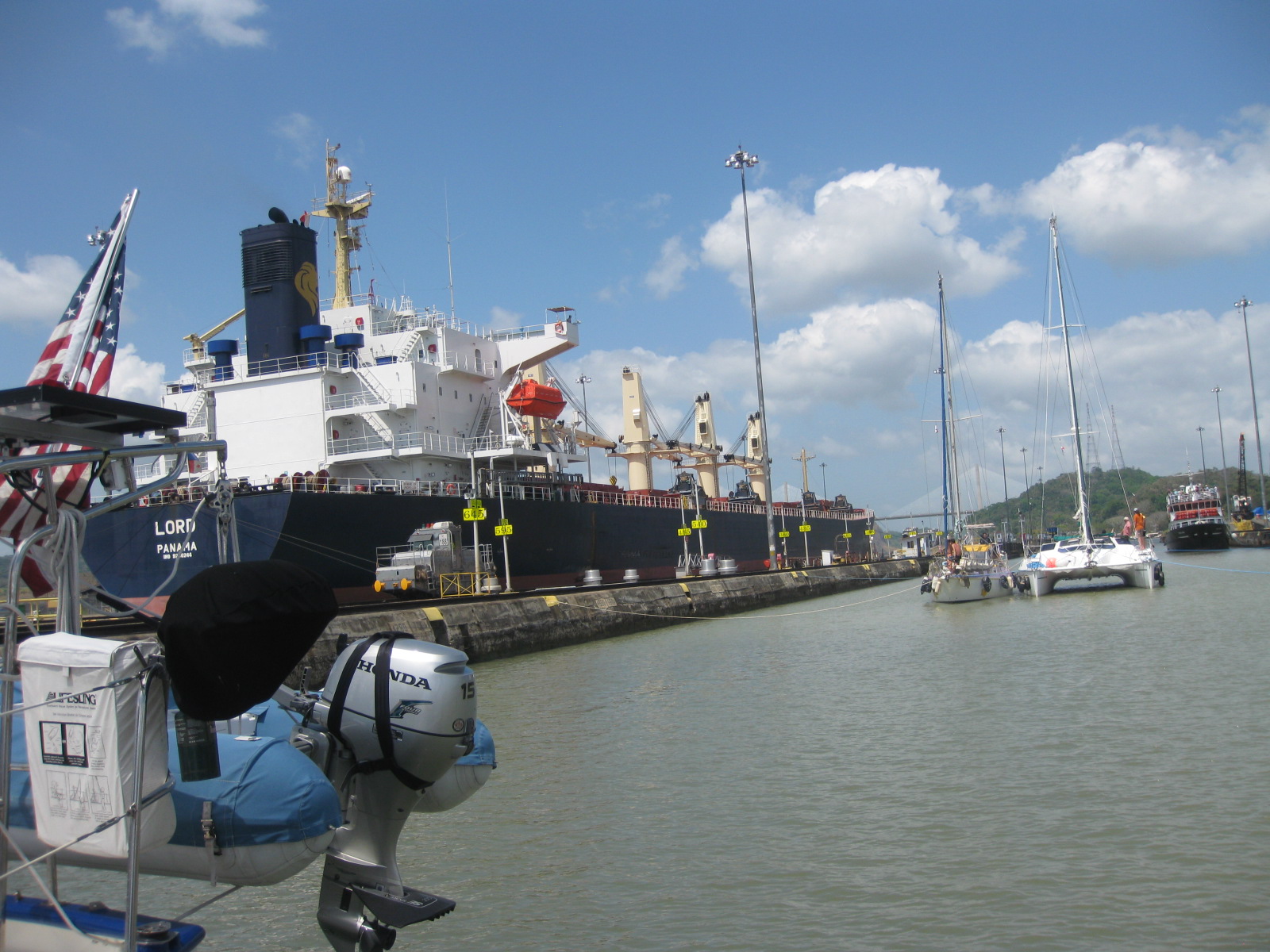
About 0530 a pilot boat revved up in the distance, then steered our way to distribute pilots and guides to the various vessels for the day's transits.  One of the bulk carriers (freighters) was named simply the Lord, of Panamanian registry.  As I lay in my bunk in the forecastle of the McPelican, looking up through an open hatchway at the sky turning pale, absorbing the ambiance of the whole thing, came booming through the radio, in a deep, full voice...

"LORD OF PANAMÁ, GOOD MORNING!"

Someone from the Canal Authority, an incoming pilot perhaps, was alerting the freighter Lord as to his arrival on board.  I was jolted from my reverie, as if he had been talking to me directly.  Laying there like that, I had been feeling like the Lord of the Universe myself! 

Regardless, it was a wake-up call to all the sleepy yachtees in our group.  On boats all around us, lights flicked on, hatches swung open, heads popped out...It was time to head across the lake and to lower, "to lock down," as they call it, on the other side to Pacific-level and thus complete the transit.

Our lock time at the Pedro Miquel Lock was 1140, so no time to linger -- miles to go and an appointment to keep.  It was crank up the engines, take the guides on board, and away all boats.


Sunrise on Lake Gatún.


Meeting northbound traffic, as our little flotilla of yachts motors the lake.


We wait for this freighter to pass before rafting up with these two yachts on the port side.


 "Lord of Panama," a bulk carrier, working its way through a lock.  Note the two yachts tied together off to its right.


Now, a month-plus later, what stays with me the most about it all is the spectacle, especially on the Pacific-end.  Viewing the famous Gaillard Cut, where the channel had to be dug and blasted out through the Continental Divide -- no Rocky Mountains here, but an imposing ridge line nonetheless -- I came to appreciate the mighty effort put forth to make this thing.  And it was accomplished a hundred-and-some years ago!  In the heat and the mosquitoes and with olden equipment yet.  No wonder thousands died to the process.


The Gaillard Cut, with the Centennial Bridge in the background.
 

After descending the Miraflores Locks, the final obstacle to the Pacific, we putted silently along a miles-long corridor of exit buoys, everyone alone with his thoughts... 

Right on cue, freighters heaped with a thousand-or-so containers apiece steamed in out of the haze and under the soaring arches of the Bridge of the Americas.  They glided by a few hundred feet away -- pulsing, throbbing steel monsters.  We had passed dozens of ships coming through, but these were the biggest, and both humbled and amazed us.


Crossroads of the world:  Massive container ships steam in as traffic rushes overhead on the Bridge of the Americas, effectively connecting North to South America.  What a sight!  What a sense of x marks the spot! 


Paul, our skipper, concentrates on the exit channel as another monster passes astern.

With this passage, in a sense, I feel that I was granted a visa to a very special place -- a watery realm that, given the population of the world overall, few get to enter.

The way I saw it, it's a domain unto itself, populated with nautical giants and nimble elves, with its own laws, customs and rules of the road, all presided over by a kingly authority...A place with its own lingo and mythology; its own tales of heroes, great feats, and great tragedy.

And yes, even a place of some magic:  Watch as the stars come out over Lake Gatún or view the Centennial Bridge a-dazzle in brilliant sunshine and you'll know what I mean.  Maybe you can tell, the place had me under its spell!

All told, I spent three weeks in the Canal Zone, based at a hostel that, during the American days there, used to house canal employees.  I visited museums and visitor centers, watched ships pass daily from various shore points, frequented seafarer centers and clubs, browsed stores selling navigational supplies, talked with mariners and pilots.

As nice as these things were, I didn't really know what it was all about until I passed through on a boat.  When I got underway on McPelican, I went from observer to participant in the experience that is the Panama Canal.  Only then did I realize the energy, the real flow of this circuit between the seas.  It's a place, perhaps like no other, where you can feel the very international pulse of the planet itself.

Thanks to Paul and Bernadette and their daughter Finn, as well as others, I now have one of my greatest of travel memories.


Your humble correspondent approaching the Gatún locks.

Anyone with comments or questions can reach me directly at mordoman@yahoo.com   
I'll answer all queries as promptly as I can.


A key chain I brought back -- one of my favorite of all souvenirs.


THE END


Thursday, January 20, 2011

Siesta-Time By The Seashore


Juan Pablo walks the beach at Pavones at low tide

No doubt some of you have realized, my posts have been sparse in here of late.  Plain and simple, it´s a law of physics applied to human endeavor:  what goes up must come down.

Perhaps call this the two-month lull.  Whatever you call it, after about two months on these journeys I deflate as far as writing or picture-taking or just plain traveling.  It becomes an effort just to pick up the camera and compose a shot, much less stow my duffel on another bus or dig out the passport and check into another hostel  Yes, the dreaded globe-trekker burn-out had set in.


After two months, your humble correspondent in yet another bus station

Give me a wracked up back, a tropical cold, a rumbling and phizzing in the intestines (all of which I had in the pic above) but don´t give me that!  The onslaught of burn-out takes the mind, you understand, and that´s the main reason for going through it all anyhow. 

This time it hit me on the Pan-American Highway, approaching the Panama/Costa Rica border.  Juan Pablo, the olive oil farmer and country gentlemen from Italy who I had been traveling with, much more of a world traveler than I, knew the treatment immediately -- one week at the seashore.

By coincidence, he had a friend who lived along the Pacific Ocean relatively close by.  We got our passports stamped at Paso Canoes border crossing, sailing right through for once, and hopped the next bus for the coast.

Endless banana plantations en route to Pavones
What Juan Pablo didn´t tell me was that it would practically be a marathon getting in there -- three changes of buses, all of them jammed, with hours of waiting involved.

The route itself wound over dirt roads with protruding rocks and huge potholes.  My back took a pounding and I was yelping with pain and muttering at him by the time we got there, well after dark.

However, the isolated and quiet little town by the sea was just what we needed.  Both of us slept and slept...Besides eating and gabbing our main activity was taking long walks in the evening along beaches strewn with black volcanic formations.  This is why so many sunset pics accompany this post -- that was about the only time I picked up the camera!

Pavones, the name of the little beach town, was just what the doctor ordered, in other words, for weary travelers.

After such a time getting in there, this seems a good place to insert my patented Five Rules For World Travel.  By popular demand and all that.  Count this as a bonus to my faithful readers because someday these only will be available in my book, The Consummate World Traveler, and you´ll have to pay big for them.

At any rate, in abbreviated form, here they are:
  1. Prepare
  2. Get There
  3. Execute
  4. Record
  5. Reflect         
For example, the arduous bus journey into Pavones was a clear exercise of rule Number Two.  No matter how tired you are or how you feel, sometimes you have to draw upon whatever resources you can, inner or otherwise, and get there.  Suck in the gut, in other words, and do it.

Dare I say it, faith plays a role...Get there and things will work out.  Or at least that´s the way it works for me.

Carol of Carol´s Cabinas
This time, after getting there, I landed at a place called Carol´s Cabinas.  Its owner is a New Zealander, a "kiwi" as they call them.

In general Carol was pleasant of personality, but with mouth that´d make a First Mate on a tramp steamer blush.  She had a knack for working the f-word into sentences two and three times, and often that was in addition to obscenities already interspersed.

A bottle of liquor was centered on the table when she and her girlfriend had lunch, and with good reason.  It was dolloped at intervals into their tropical juice drinks.  

Despite her saltiness, she made available the little things, the mark of a good hostess.  A huge bunch of bananas, for example, hung in the communal kitchen area, available for the plucking to anyone wanting smoothies or a snack.  Mosquito netting, fine-meshed and treated with insecticide, was draped over the beds and her personal laptop was available to guests wanting to use the Internet.

She was a little lax on the pruning, so the jungle had grown in upon the entrance walk to my room.  I had to part huge waxy leaves, usually dripping with water, to get inside.  Maroon flowers festooned the lushness here and there, and in the morning you didn´t have to go far to get a show with the wildlife.

I´d wake up and shuffle out through shafts of sunlight to the kitchen area to the distant calls of monkeys.  Huge red parrots, called scarlet macaws, would hop from branch to branch, reminding me of cardinals back in Penna., only with tail plumage longer than their entire bodies.

Most spectacular were the butterflies.  Some are called mariposa azul.  Their brilliant blue made us gasp with delight every time we saw them. This image -- of these sapphire-like jewels flapping erratically through that vegetation -- remains one of the most vivid of the whole trip.

Pavones itself was a surfer town with almost no surfers.  The big breaks don´t materialize until spring, so the guest houses and restaurantes were almost deserted.  This was good for us because the prices were down, especially for lodging.  My room at Carol´s with private bath and hammocks out front, and all the goodies thrown in, was $10 U.S. per night.  For most of the week, there was only two guests.


The surf-point-with-no-surfers thing was interesting in itself.  The artwork about-town especially.  It was like wandering a temple and viewing faded frescoes of the gods.  Images of bronzed young men with washboard-like stomachs (or women in bikinis) clasping long boards loomed from wall after wall, making me feel small and out of shape.  Carol talked about waves that were only a few "hands" tall, a surfer term that means "feet," and how it was low tide there as far as business.

It also was a good time to put into practice Number Five of Jim´s Rules of Travel -- Reflect.  Through the previous two months I had been in three countries, met a lot people and done a lot of things.  There had been a few rough times but generally it had been a fantastic experience.  Colombia, especially, was some of the best travels I´d ever had.

New Year´s Eve, bonfires flared up here and there along the beaches.  As I watched them crackle and burn through the waning hours of 2010, I passed this plethora of experiences through my mind, one by one.  Most I savored and some I cringed over.  As best as I could, I let them work back into the receptacles of memory, to where the good stuff is stored.

If I had a wish or resolution for 2011, it would be that I could remember it all for a long, long time.


Last bonfire of 2010 -- New Year´s Eve at Pavones Beach


Low tide at Pavones Beach


Monday, January 3, 2011

Passage To Panama, Part III


Our unofficial prison at the edge of the Darien

With Yours Truly stranded on foreign shores, however temporarily, it seems a good time to resurrect that pesky question often put to me, "Jim, whyfore do you travel so?"

Sometimes it takes a while to get to, but generally I answer with my tried and true statement:  "The mission," I explain, "is to explore other peoples and other cultures."  

This, then, is what I set out to do that first full morning in Puerto Olbadia, to explore and to experience the culture there.  And it is unique -- maybe not the most exciting, especially to adventure-seeking turistas, maybe not the tidiest, but unique nonetheless.


One reason that I set off along this coast in the first place was to visit the San Blas Islands, which are farther up along the Darien Coast.  Here live the bulk of the Kuna Tribespeople -- tribus or tribals as they call them here.  In fact, this whole stretch is sometimes called the "Kuna Coast." 


Puerto Obladia, as it turned out, was home to several families of Kunas, and I got to see and learn some about them close up.  This was not a Kuna village per se, you understand; more like a few were sprinkled into the local population.


They didn't want their pictures taken, at least close up.  So check the Internet for a good look.  Kuna women, in particular, are walking bazaars of color.  Among the most colorful people I've ever seen.  Their philosophy seems to be that no patch of skin will be left unadorned.  Even the stretch between the ankles and knees is encircled with sheaths of eye-popping bead work.


They speak their own language, with a little Spanish thrown in.  So I was not able to communicate with them.  I decided to be more like a voyeur.  Or as Yogi Berra would say, you can observe a lot about people just by watching them.  As it turned out, I had lots and lots of time to do just that.


A "coaster" coming to call

One of the big events in P.O. was the arrival of "coasters" or local freighters.  You could tell when one got there as the locals would scurry toward the waterfront.  This was almost opposed to their usual gait, which was kind of a flip-flop shuffle, usually with gaze cast downward.


As beat up as I was, these craft aroused something in me, I will admit...something beyond my usual penchant for boat rides.  It seems that the Darien itself had been working my mind.  Like a siren doing a seductive dance of danger and intrigue, it had cast a spell over me and was drawing me farther and farther...of which coasters were a means to that end.


For what it´s worth, when I mentioned this to Juan Pablo and Santiago, they thought I was coming down with something

Almost everything comes in via the water here, from clothes to electronics to most of the food.  Which was a surprise -- you would think that such a place would be fairly brimming with tropical fruits and vegetables.  But this was not the case in P.O.

I saw a few scraggly tomato plants here and there, a few papayas, but that was about it.  I never did find out why, as the soil seemed fertile enough to grow all kinds of things.


Our hang-out was next to door to Pension Cande, a place called Restaurante Las Tres Ls.  Its owner and chief-cook-and-bottle-washer was a lady named Lorenca.  I took a can of tuna into her once, thinking such an establishment surely would have a can opener.  To my surprise, she whipped out a bright and shining butcher knife.  With teeth clenched, she ripped it around and open with that big thing as nice as could be.  

She spat out words in Spanish like a machine gun, which I figured was a plot so I wouldn´t know what I was ordering.  And no wonder.  The first night she served deep-fried pig´s tail.  That was it.  No second choices.  Her main course was served with rice, beans, maybe a few slices of carrots, and called plato del día in Spanish, plate of the day.


The second day it was deep-fried cow´s intestine, sliced up into strips.  The third was deep-dried spam...spam, deep fried, I say.  The plates pooled with so much oil you could lubricate a crankshaft.

Juan Pablo and Santiago preparing to depart
Two things I´ll remember about her place:  First, walking in there before the power came on for the evening with diners sitting around woofing her plato del dia by candles.  Every table was a little island of light, including in the kitchen where she was serving.  Which was kind of romantic, until you saw the place with the lights on.


And second,  finally seeing one place where the food overall was worse than the American diet.  And from the size and number of bubble butts (and bubble guts) waddling around, it appeared that Lorenca´s fare was typical for P.O.

The third day was marked by the appearance of the mysterious Mad Russian.  How he got there, no one knew.  He was walking the streets, hands clasped before him, mumbling like some sort of de-ranged Byzantine holy man.  He´d approach some one, babble a few words, and then dart away...Kind of a hard fella to get to know.

Our team was divided on him:  Juan Pablo thought that he was another Dostoyevsky, the great Russian writer.  Santiago had him as an Argentian poet/philospher of renown.  For my part, I thought he was just another nut-job from Eastern Europe.

His name was Vladimir, we did find out.  He had an interest in tribal cultures and earlier in life had worked at the famous Hermitage Museum in St. Petersburg.  He somehow wangled his name in front of ours on the passenger list with Air Panama, which didn´t go over well, as long as we had been waiting.  When we protested, he exclaimed, "I am reserved, I am reserved!" and slunk away.

In general, we found it best to steer clear of the Mad Russian.  Like most of the residents of P.O., they tolerated us and we tolerated them, both parties knowing that we wouldn´t be there long.  But the Russian did provide some entertainment as our time there finally, mercifully was coming to an end.


If there's a moral or whatever out of the whole thing, it probably has to do with patience.  Waiting, fortified with patience, is so much of the daily routine here.  The locals always seem to be practicing it -- waiting out the rain, waiting for the catch of the day to come in, waiting for a plane.  This would drive most hurry-and-do-it Caucasians crazy, as it almost did us, but in P.O. it's just life.


Airport waiting lounge -- Puerto Obladia

A few footnotes:
  • Flying out toward Panama City, miles high over the Darien, you can see why the government has concerns.  The green-clad hills and valleys go on and on, broken only by looping rivers and swelling lakes of brown water, where the lowlands were flooding from all the rain.  It`s still a wild and untamed land.  To expect Panama, very much a Banana Republic, to exert control down there would be asking something that possibly not even the U.S. could manage.

  • Upon landing in Panama City, the whole planeload of us (18) was declared "passengers of interest" by the govt. and our passports seized as we disembarked.  We were put into a hot, stuffy room...no food, no water, the restrooms locked, with armed guards nearby.  One by one we were grilled by security officials -- what were we doing down there, where had we come from, who did we know there, etc.  P.O. had seen an upsurge of insurgents of late and the govt. feared that some might have gotten onto the plane.  Only when our passports were handed back four hours later, were we finally free to go.


  • With two weeks gone by now, it appears that I may have escaped contracting malaria, despite all the mosquito bites.  Santiago, however, the youngest of our trio at 26 and who only received a few bites, has been displaying symptoms -- waves of fever and chills, muscle aches, nausea and so on -- and has had to seek medical attention.  As a result, he has had to cut short his epic journey up the length of the Americas and head back to Argentina.                                          


The agent of our deliverance -- Air Panama


The Mad Russian leads the exodus on, followed by a few tribus, among others