The Golden Temple Of The Sikhs

The Golden Temple Of The Sikhs
The Golden Temple of the Sikhs, in the Punjab region of northwestern India.

The Wagah Border Crossing, one of the most contentious borders in the world. I crossed here and spent an oh-so rewarding week inside Pakistan.

Thursday, March 28, 2013

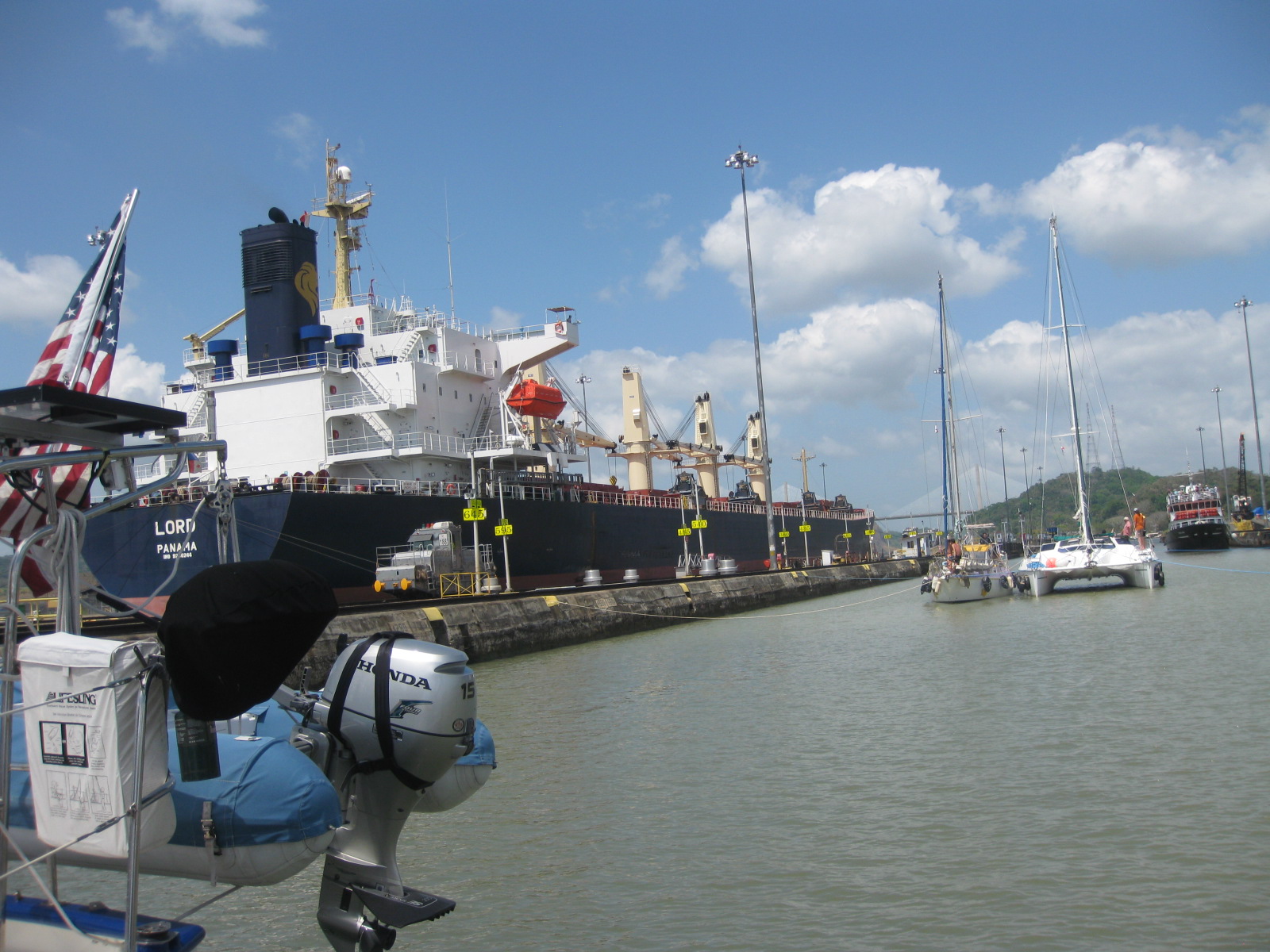
Lord of Panamá, Good Morning! (transiting the Panama Canal)


The Canal from the Balboa Yacht Club, on the Pacific side.


 For The Information Of All Hands:

It's taken a couple of weeks rooting around down here in the Canal Zone to hook up, but I finally have gotten my ride.  Tomorrow morning, 1000 hrs. approx., I will be boarding the McPelican, a 42-foot sailing yacht of Australian registry, and will be transiting the Panama Canal.  It'll take two days in all to get through, I'm told, and we'll moor somewhere along Lake Gatún for the night, about halfway through.

I'll be singing for my supper on this one, so to speak, as I'll be working on board as a line-handler.  Each boat or yacht passing through needs a pilot and four line-handlers, one on each "quarter" (or two on each side) as per Canal Authority regs.

The bigger ships, including those called Panama-max as they are the maximum size that can fit into the locks, use a different system involving what they call "mules" (electric locomotives) for positioning and securing within the locks.  But the smaller ones, such as ours, still use good ol' fashioned hand power.

At any rate, this is all very exciting and the event will be duly recorded with pics and maybe some videos, so stay tuned.

Hasta Luego to you all from this, the most famous shortcut in the world.


Yours,

"Panama Jim"


   -- email that I sent out to various people Feb. 13 of this year, a Wednesday.  

The next day, Valentine's Day, I banged in a taxi over a pot-holed road winding through jungle and palms, up to the remnants of a U.S. Army base, Fort Sherman.  Most of its buildings had been stripped by scavengers -- an eerie ride-through, right out of the Twilight Zone, as generally only concrete hulks with roofs remain.  It was though a great civilization had been there and left.

We cleared through a check station manned by Panamanian soldiers in digitized camo and with automatic rifles, eventually arriving at Shelter Bay Marina, along the steamy Caribbean Coast.  After a brief search in blinding sunshine through the maze of slips, I found my boat -- the McPelican


That's Paul, captain and co-owner, on deck.  Note the tire bumpers along the side for "rafting up"with other yachts to go through locks.


Underway toward the canal entrance, Caribbean side.  These ships are anchored, waiting to "transit" -- sometimes for a week or even two!


About to "raft up" with Shellback out of Long Beach, CA.  Two or three yachts tie up into one unit and go through the locks together.


Rafted up to Shellback and a third yacht (out of sight) we creep into the Gatún locks.  Note lock door, weighing 650 tons, at right.
                                                            

It was trickier than I thought, especially when the locks flooded in with water.  It comes rushing out of huge pipes and causes a roiling, swirling current which snaps the lines taut and wants to twirl boats against the concrete walls.  This happens as warning bells clang, horns blare, seagulls and other birds flap about, and pilots and lock workers yell orders sometimes in two different languages.

Fortunately, Dillon and Sietst, two of the other line-handlers, had been through it all many times and showed me the ropes.  Bernadette, one of the owners of the boat, was a nerve-case the whole time.  McPelican was quite an investment for them and she was sweating any damage that might occur.  She put that energy to positive use, though, down in the galley where she whipped up some delicious meals.


Manning the lines in the Pedro Miguel Lock.  The towel on my head is protection from the blazing sun.  Dillon takes shelter from it under the sail.


Up, up, up to Lake Gatún...That's three "lock-ups" at the Gatún Locks to get you up to lake level.  This is the heart of the canal transit -- Lago de Gatún.  Note lower level of channel off in background, with the Caribbean Sea beyond.


It took us two days to get through.  What made it a true adventure was spending the night out on Lake Gatún, about eighty-five feet above ocean-level (that's what the locks do -- hoist us up to that level).  All night the water was as calm and quiet as a puddle, even though the lake's 35 kilometers (21 miles) long, and the sky bristled with stars.

An hour before dawn howler monkeys started up from various points, working up to a crescendo of ape-like grunts; roosters crowed from jungle villages; and the smells of coffee and bacon wafted in from yachts and massive freighters anchored around us.

About 0530 a pilot boat revved up in the distance, then steered our way to distribute pilots and guides to the various vessels for the day's transits.  One of the bulk carriers (freighters) was named simply the Lord, of Panamanian registry.  As I lay in my bunk in the forecastle of the McPelican, looking up through an open hatchway at the sky turning pale, absorbing the ambiance of the whole thing, came booming through the radio, in a deep, full voice...

"LORD OF PANAMÁ, GOOD MORNING!"

Someone from the Canal Authority, an incoming pilot perhaps, was alerting the freighter Lord as to his arrival on board.  I was jolted from my reverie, as if he had been talking to me directly.  Laying there like that, I had been feeling like the Lord of the Universe myself! 

Regardless, it was a wake-up call to all the sleepy yachtees in our group.  On boats all around us, lights flicked on, hatches swung open, heads popped out...It was time to head across the lake and to lower, "to lock down," as they call it, on the other side to Pacific-level and thus complete the transit.

Our lock time at the Pedro Miquel Lock was 1140, so no time to linger -- miles to go and an appointment to keep.  It was crank up the engines, take the guides on board, and away all boats.


Sunrise on Lake Gatún.


Meeting northbound traffic, as our little flotilla of yachts motors the lake.


We wait for this freighter to pass before rafting up with these two yachts on the port side.


 "Lord of Panama," a bulk carrier, working its way through a lock.  Note the two yachts tied together off to its right.


Now, a month-plus later, what stays with me the most about it all is the spectacle, especially on the Pacific-end.  Viewing the famous Gaillard Cut, where the channel had to be dug and blasted out through the Continental Divide -- no Rocky Mountains here, but an imposing ridge line nonetheless -- I came to appreciate the mighty effort put forth to make this thing.  And it was accomplished a hundred-and-some years ago!  In the heat and the mosquitoes and with olden equipment yet.  No wonder thousands died to the process.


The Gaillard Cut, with the Centennial Bridge in the background.
 

After descending the Miraflores Locks, the final obstacle to the Pacific, we putted silently along a miles-long corridor of exit buoys, everyone alone with his thoughts... 

Right on cue, freighters heaped with a thousand-or-so containers apiece steamed in out of the haze and under the soaring arches of the Bridge of the Americas.  They glided by a few hundred feet away -- pulsing, throbbing steel monsters.  We had passed dozens of ships coming through, but these were the biggest, and both humbled and amazed us.


Crossroads of the world:  Massive container ships steam in as traffic rushes overhead on the Bridge of the Americas, effectively connecting North to South America.  What a sight!  What a sense of x marks the spot! 


Paul, our skipper, concentrates on the exit channel as another monster passes astern.

With this passage, in a sense, I feel that I was granted a visa to a very special place -- a watery realm that, given the population of the world overall, few get to enter.

The way I saw it, it's a domain unto itself, populated with nautical giants and nimble elves, with its own laws, customs and rules of the road, all presided over by a kingly authority...A place with its own lingo and mythology; its own tales of heroes, great feats, and great tragedy.

And yes, even a place of some magic:  Watch as the stars come out over Lake Gatún or view the Centennial Bridge a-dazzle in brilliant sunshine and you'll know what I mean.  Maybe you can tell, the place had me under its spell!

All told, I spent three weeks in the Canal Zone, based at a hostel that, during the American days there, used to house canal employees.  I visited museums and visitor centers, watched ships pass daily from various shore points, frequented seafarer centers and clubs, browsed stores selling navigational supplies, talked with mariners and pilots.

As nice as these things were, I didn't really know what it was all about until I passed through on a boat.  When I got underway on McPelican, I went from observer to participant in the experience that is the Panama Canal.  Only then did I realize the energy, the real flow of this circuit between the seas.  It's a place, perhaps like no other, where you can feel the very international pulse of the planet itself.

Thanks to Paul and Bernadette and their daughter Finn, as well as others, I now have one of my greatest of travel memories.


Your humble correspondent approaching the Gatún locks.

Anyone with comments or questions can reach me directly at mordoman@yahoo.com   
I'll answer all queries as promptly as I can.


A key chain I brought back -- one of my favorite of all souvenirs.


THE END


Thursday, January 20, 2011

Siesta-Time By The Seashore


Juan Pablo walks the beach at Pavones at low tide

No doubt some of you have realized, my posts have been sparse in here of late.  Plain and simple, it´s a law of physics applied to human endeavor:  what goes up must come down.

Perhaps call this the two-month lull.  Whatever you call it, after about two months on these journeys I deflate as far as writing or picture-taking or just plain traveling.  It becomes an effort just to pick up the camera and compose a shot, much less stow my duffel on another bus or dig out the passport and check into another hostel  Yes, the dreaded globe-trekker burn-out had set in.


After two months, your humble correspondent in yet another bus station

Give me a wracked up back, a tropical cold, a rumbling and phizzing in the intestines (all of which I had in the pic above) but don´t give me that!  The onslaught of burn-out takes the mind, you understand, and that´s the main reason for going through it all anyhow. 

This time it hit me on the Pan-American Highway, approaching the Panama/Costa Rica border.  Juan Pablo, the olive oil farmer and country gentlemen from Italy who I had been traveling with, much more of a world traveler than I, knew the treatment immediately -- one week at the seashore.

By coincidence, he had a friend who lived along the Pacific Ocean relatively close by.  We got our passports stamped at Paso Canoes border crossing, sailing right through for once, and hopped the next bus for the coast.

Endless banana plantations en route to Pavones
What Juan Pablo didn´t tell me was that it would practically be a marathon getting in there -- three changes of buses, all of them jammed, with hours of waiting involved.

The route itself wound over dirt roads with protruding rocks and huge potholes.  My back took a pounding and I was yelping with pain and muttering at him by the time we got there, well after dark.

However, the isolated and quiet little town by the sea was just what we needed.  Both of us slept and slept...Besides eating and gabbing our main activity was taking long walks in the evening along beaches strewn with black volcanic formations.  This is why so many sunset pics accompany this post -- that was about the only time I picked up the camera!

Pavones, the name of the little beach town, was just what the doctor ordered, in other words, for weary travelers.

After such a time getting in there, this seems a good place to insert my patented Five Rules For World Travel.  By popular demand and all that.  Count this as a bonus to my faithful readers because someday these only will be available in my book, The Consummate World Traveler, and you´ll have to pay big for them.

At any rate, in abbreviated form, here they are:
  1. Prepare
  2. Get There
  3. Execute
  4. Record
  5. Reflect         
For example, the arduous bus journey into Pavones was a clear exercise of rule Number Two.  No matter how tired you are or how you feel, sometimes you have to draw upon whatever resources you can, inner or otherwise, and get there.  Suck in the gut, in other words, and do it.

Dare I say it, faith plays a role...Get there and things will work out.  Or at least that´s the way it works for me.

Carol of Carol´s Cabinas
This time, after getting there, I landed at a place called Carol´s Cabinas.  Its owner is a New Zealander, a "kiwi" as they call them.

In general Carol was pleasant of personality, but with mouth that´d make a First Mate on a tramp steamer blush.  She had a knack for working the f-word into sentences two and three times, and often that was in addition to obscenities already interspersed.

A bottle of liquor was centered on the table when she and her girlfriend had lunch, and with good reason.  It was dolloped at intervals into their tropical juice drinks.  

Despite her saltiness, she made available the little things, the mark of a good hostess.  A huge bunch of bananas, for example, hung in the communal kitchen area, available for the plucking to anyone wanting smoothies or a snack.  Mosquito netting, fine-meshed and treated with insecticide, was draped over the beds and her personal laptop was available to guests wanting to use the Internet.

She was a little lax on the pruning, so the jungle had grown in upon the entrance walk to my room.  I had to part huge waxy leaves, usually dripping with water, to get inside.  Maroon flowers festooned the lushness here and there, and in the morning you didn´t have to go far to get a show with the wildlife.

I´d wake up and shuffle out through shafts of sunlight to the kitchen area to the distant calls of monkeys.  Huge red parrots, called scarlet macaws, would hop from branch to branch, reminding me of cardinals back in Penna., only with tail plumage longer than their entire bodies.

Most spectacular were the butterflies.  Some are called mariposa azul.  Their brilliant blue made us gasp with delight every time we saw them. This image -- of these sapphire-like jewels flapping erratically through that vegetation -- remains one of the most vivid of the whole trip.

Pavones itself was a surfer town with almost no surfers.  The big breaks don´t materialize until spring, so the guest houses and restaurantes were almost deserted.  This was good for us because the prices were down, especially for lodging.  My room at Carol´s with private bath and hammocks out front, and all the goodies thrown in, was $10 U.S. per night.  For most of the week, there was only two guests.


The surf-point-with-no-surfers thing was interesting in itself.  The artwork about-town especially.  It was like wandering a temple and viewing faded frescoes of the gods.  Images of bronzed young men with washboard-like stomachs (or women in bikinis) clasping long boards loomed from wall after wall, making me feel small and out of shape.  Carol talked about waves that were only a few "hands" tall, a surfer term that means "feet," and how it was low tide there as far as business.

It also was a good time to put into practice Number Five of Jim´s Rules of Travel -- Reflect.  Through the previous two months I had been in three countries, met a lot people and done a lot of things.  There had been a few rough times but generally it had been a fantastic experience.  Colombia, especially, was some of the best travels I´d ever had.

New Year´s Eve, bonfires flared up here and there along the beaches.  As I watched them crackle and burn through the waning hours of 2010, I passed this plethora of experiences through my mind, one by one.  Most I savored and some I cringed over.  As best as I could, I let them work back into the receptacles of memory, to where the good stuff is stored.

If I had a wish or resolution for 2011, it would be that I could remember it all for a long, long time.


Last bonfire of 2010 -- New Year´s Eve at Pavones Beach


Low tide at Pavones Beach


Monday, January 3, 2011

Passage To Panama, Part III


Our unofficial prison at the edge of the Darien

With Yours Truly stranded on foreign shores, however temporarily, it seems a good time to resurrect that pesky question often put to me, "Jim, whyfore do you travel so?"

Sometimes it takes a while to get to, but generally I answer with my tried and true statement:  "The mission," I explain, "is to explore other peoples and other cultures."  

This, then, is what I set out to do that first full morning in Puerto Olbadia, to explore and to experience the culture there.  And it is unique -- maybe not the most exciting, especially to adventure-seeking turistas, maybe not the tidiest, but unique nonetheless.


One reason that I set off along this coast in the first place was to visit the San Blas Islands, which are farther up along the Darien Coast.  Here live the bulk of the Kuna Tribespeople -- tribus or tribals as they call them here.  In fact, this whole stretch is sometimes called the "Kuna Coast." 


Puerto Obladia, as it turned out, was home to several families of Kunas, and I got to see and learn some about them close up.  This was not a Kuna village per se, you understand; more like a few were sprinkled into the local population.


They didn't want their pictures taken, at least close up.  So check the Internet for a good look.  Kuna women, in particular, are walking bazaars of color.  Among the most colorful people I've ever seen.  Their philosophy seems to be that no patch of skin will be left unadorned.  Even the stretch between the ankles and knees is encircled with sheaths of eye-popping bead work.


They speak their own language, with a little Spanish thrown in.  So I was not able to communicate with them.  I decided to be more like a voyeur.  Or as Yogi Berra would say, you can observe a lot about people just by watching them.  As it turned out, I had lots and lots of time to do just that.


A "coaster" coming to call

One of the big events in P.O. was the arrival of "coasters" or local freighters.  You could tell when one got there as the locals would scurry toward the waterfront.  This was almost opposed to their usual gait, which was kind of a flip-flop shuffle, usually with gaze cast downward.


As beat up as I was, these craft aroused something in me, I will admit...something beyond my usual penchant for boat rides.  It seems that the Darien itself had been working my mind.  Like a siren doing a seductive dance of danger and intrigue, it had cast a spell over me and was drawing me farther and farther...of which coasters were a means to that end.


For what it´s worth, when I mentioned this to Juan Pablo and Santiago, they thought I was coming down with something

Almost everything comes in via the water here, from clothes to electronics to most of the food.  Which was a surprise -- you would think that such a place would be fairly brimming with tropical fruits and vegetables.  But this was not the case in P.O.

I saw a few scraggly tomato plants here and there, a few papayas, but that was about it.  I never did find out why, as the soil seemed fertile enough to grow all kinds of things.


Our hang-out was next to door to Pension Cande, a place called Restaurante Las Tres Ls.  Its owner and chief-cook-and-bottle-washer was a lady named Lorenca.  I took a can of tuna into her once, thinking such an establishment surely would have a can opener.  To my surprise, she whipped out a bright and shining butcher knife.  With teeth clenched, she ripped it around and open with that big thing as nice as could be.  

She spat out words in Spanish like a machine gun, which I figured was a plot so I wouldn´t know what I was ordering.  And no wonder.  The first night she served deep-fried pig´s tail.  That was it.  No second choices.  Her main course was served with rice, beans, maybe a few slices of carrots, and called plato del día in Spanish, plate of the day.


The second day it was deep-fried cow´s intestine, sliced up into strips.  The third was deep-dried spam...spam, deep fried, I say.  The plates pooled with so much oil you could lubricate a crankshaft.

Juan Pablo and Santiago preparing to depart
Two things I´ll remember about her place:  First, walking in there before the power came on for the evening with diners sitting around woofing her plato del dia by candles.  Every table was a little island of light, including in the kitchen where she was serving.  Which was kind of romantic, until you saw the place with the lights on.


And second,  finally seeing one place where the food overall was worse than the American diet.  And from the size and number of bubble butts (and bubble guts) waddling around, it appeared that Lorenca´s fare was typical for P.O.

The third day was marked by the appearance of the mysterious Mad Russian.  How he got there, no one knew.  He was walking the streets, hands clasped before him, mumbling like some sort of de-ranged Byzantine holy man.  He´d approach some one, babble a few words, and then dart away...Kind of a hard fella to get to know.

Our team was divided on him:  Juan Pablo thought that he was another Dostoyevsky, the great Russian writer.  Santiago had him as an Argentian poet/philospher of renown.  For my part, I thought he was just another nut-job from Eastern Europe.

His name was Vladimir, we did find out.  He had an interest in tribal cultures and earlier in life had worked at the famous Hermitage Museum in St. Petersburg.  He somehow wangled his name in front of ours on the passenger list with Air Panama, which didn´t go over well, as long as we had been waiting.  When we protested, he exclaimed, "I am reserved, I am reserved!" and slunk away.

In general, we found it best to steer clear of the Mad Russian.  Like most of the residents of P.O., they tolerated us and we tolerated them, both parties knowing that we wouldn´t be there long.  But the Russian did provide some entertainment as our time there finally, mercifully was coming to an end.


If there's a moral or whatever out of the whole thing, it probably has to do with patience.  Waiting, fortified with patience, is so much of the daily routine here.  The locals always seem to be practicing it -- waiting out the rain, waiting for the catch of the day to come in, waiting for a plane.  This would drive most hurry-and-do-it Caucasians crazy, as it almost did us, but in P.O. it's just life.


Airport waiting lounge -- Puerto Obladia

A few footnotes:
  • Flying out toward Panama City, miles high over the Darien, you can see why the government has concerns.  The green-clad hills and valleys go on and on, broken only by looping rivers and swelling lakes of brown water, where the lowlands were flooding from all the rain.  It`s still a wild and untamed land.  To expect Panama, very much a Banana Republic, to exert control down there would be asking something that possibly not even the U.S. could manage.

  • Upon landing in Panama City, the whole planeload of us (18) was declared "passengers of interest" by the govt. and our passports seized as we disembarked.  We were put into a hot, stuffy room...no food, no water, the restrooms locked, with armed guards nearby.  One by one we were grilled by security officials -- what were we doing down there, where had we come from, who did we know there, etc.  P.O. had seen an upsurge of insurgents of late and the govt. feared that some might have gotten onto the plane.  Only when our passports were handed back four hours later, were we finally free to go.


  • With two weeks gone by now, it appears that I may have escaped contracting malaria, despite all the mosquito bites.  Santiago, however, the youngest of our trio at 26 and who only received a few bites, has been displaying symptoms -- waves of fever and chills, muscle aches, nausea and so on -- and has had to seek medical attention.  As a result, he has had to cut short his epic journey up the length of the Americas and head back to Argentina.                                          


The agent of our deliverance -- Air Panama


The Mad Russian leads the exodus on, followed by a few tribus, among others


Monday, December 27, 2010

Passage To Panama, Part II


First look at Puerto Obladia, Panama

The second boat trip was nothing like the previous one.  The craft itself was smaller and sleeker, and when we motored out into the open Caribbean it was obvious from the first that it was in expert hands.  

When the green ridges of water came sweeping in again, I grasped the seat in near panic, harking back to a few days earlier.  But a rhythm under way was soon established.  As a wave loomed in on us our coxswain would gun the engine, taking us up, up, up, up...through a burst of spray at the crest, then he´d ease us down, down, down.....  

Hey, I lightened after a while, this is the way it´s supposed to be -- kind of fun.

Eventually the spray worked within the neck of my poncho and trickled down my shirt, but even that wasn´t bad -- nice, warm water and with the salt pleasant tasting on the lips.

When we swung in toward Puerto Obladia after an hour-and-a-half, I was grinning ear-to-ear and feeling like a sailor again.  But this was soon tempered as we idled down and tossed in toward the ramshackle dock -- a Panamanian soldier in camo fatigues, automatic weapon on the slung, sauntered out as a sort of greeting committee.


Disembarking at Puerto Obladia -- Santiago and Juan Pablo gather up their packs

Which leads me to another of my mistakes, of which there had already been several this week -- not realizing how serious the situation was there.

En route we had crossed the international border into Panama.  Puerto Obladia and other small ports along this coast border the infamous Darien jungles, lair of guerrillas, terrorists, smugglers, drug traffickers and hordes and hordes of mosquitoes.  Where we were about to land then, was somewhat of an armed camp, an outpost on the edge of this dangerous wilderness.  The Army keeps bunkers, manned and ready, at each end of town and on the hill overlooking it.

Furthermore, Colombia and Panama don´t get along well as the Panamanian government blames a lot of the insurrection in the Darien on forces within its southern neighbor.  And here we were, coming in wet, dumb and happy from that very direction.

At the little customs station, the officials were all frowns and made me take everything out of my duffel and lay it out.  "Everything? I asked to make sure.  "Todo," came the stern reply...Yes everything, in other words.

We finally cleared that hurdle, got our passports stamped and stepped lively toward the center of the little town.  It was about 0830 and the first flight out to Panama City was about 1000.  We wanted to ticket up and be at the airstrip in plenty of time for this one.

However, the best laid plans of mice and backpackers...One flight already had been canceled and the other was sold out, fully boo-ked, as they say here.  The next possible flight out was Sunday, four days hence.  We looked around with our mouths open, then back at each other -- four days, in this place? 

The Darien essentially isolates these pockets of people along the coast and makes them accessible only by boat or airplane.  Unless one wants to risk a long hike through that jungle with the risk of kidnapping and malaria only too prevalent, that is.

As an alternative, we would be in sort of a house or town arrest, confined to this dull and scrungy "safe zone" by the military.  But what choice did we have, return to Colombia?  The boat back had already left.  Eventually we succumbed to our fate and sought out the only hotel in town -- Pension Cande.


Your humble correspondent in front of Pension Cande

The place reminded me of a large chicken coop we had at one time back on the farm.  In some rooms, you could see daylight between boards in the walls.  Electricity was only available six hours a day, 1800 to midnight, more or less.  Water was available, often brownish-colored, much of the time anyhow.

We took a room with three bunks and an interior of concrete, more of a cell really, thinking that the solid walls would limit mosquitoes.  How naive we were. 

Its owner was an old lady with no teeth, at least half crazed, with one knee blown out and wrapped around with duct tape.  The joint actually bent inward when she walked.  We found out later that she locked herself away when her tv was powered up, so there was no help or services available after dark.

No mosquito nets were set up in our cell, so the first night we did without, thinking that we could cover ourselves with sheets and thus fend them off.  Yet one more mistake.  I didn´t realize it in the dim lighting, but my sheets were so thin that you could read a book through them.

I woke up in the morning with two dozen or so welts on my back and sides where they had bitten right through.  Santiago and Juan Pablo didn´t suffer nearly so much as their sheets were thicker.

The second night we were sitting in the courtyard and heard a tremendous racket up on the tin roofing.  As we stood, peering toward the source, we were startled to make out a pack of rats racing back and forth.  And I mean racing, as if they were trying to determine the swiftest of the lot for some kind of prize.  These were not your typical urban rats of the U.S., you understand, but their larger cousins, the jungle rats.


Cola sipping gecko -- one of our few amusements 
 

I had just hung some out when three huge buzzards swooped in to a tremendous AGGGGHHHHing racket, sending laundry flying and tearing at each other with great hooked beaks.

What a spectacle, with the feathers flying and wings flapping and all of them making that blood-curdling cry only a few meters away.  They reminded me of turkey buzzards back in Penna., only much more vile and awful-looking, with the blackish heads and beaks.  Eventually one of them dominated and it ascended to perch atop a nearby roof while the others were sent packing.

While this provided some entertainment, the reality was that we were still marooned along the Darien coast, and it was getting to us after only one day.  I couldn´t even fall back on my old stand-by, hiking, with the military restricting us so.  Of all the things in travel, boredom is one of the worst, I have found.  Perhaps it wouldn´t have been so bad if I could´ve trekked the jungle and seen the bird-life and such.

Nonetheless, I was determined to turn the whole thing into something productive and worthwhile, and I proceeded to do just that.

MORE TO FOLLOW


The main drag -- with Pension Cande in green in the background


For days Puerto Obladia was an airstrip with no planes, streets with no cars


Thursday, December 23, 2010

Passage To Panama


Ominous forecast at ferry terminal in Turbo -- which I failed to heed

It was a jinx trip right from the start.  About 0830 we left the harbor at Turbo, Colombia, in a panga boat or "ferry" jammed with about thirty people.  Twenty minutes out into the bay, through a drenching downpour, we looped back around to the terminal due to some mechanical problem.

This was bad enough because I wanted in the worst way to be out of that place.  After visiting seven cities and pueblos in Colombia through the previous five weeks, Turbo came as a shock to me.  The people who live there and along the coast are called "castañas" or those with dark brown or chestnut skin.  They´re a different lot than those inland, in Medellin and so on, to put it mildly.

Of African roots, the castañas generally are much coarser, crasser of speech and, seemingly, just plain sloppy.  Particularly irritating to me, they flick litter wherever they happen to be -- sidewalk, balcony, boat, etc. -- with no consideration or care for Mother Earth.

You can see this particularly in the harbor, which is kind of a cross between a garbage dump and a septic tank.  The surface is kind of a sudsy green, interspersed with trash, which roil with black oil swirls when the boats rev up.  On a stifling day, what an odor! 

Plus the town is boom-box central.  Huge speakers blasted tunes in Spanish from restaurants and vendor stands that seemed in competition for the loudest, most obnoxious racket, a racket these people seem to thrive on.

I spent a restless night in a place called Residencia Florida and went to use the ATM next morning.  The streets and sidewalks were lined with squeezed-out orange skins, where juice vendors had just tossed them aside by the scores -- and vandals had picked them up.  The door to the ATM was spattered, the ATM buttons themselves had been gooed up, and so on.   The whole town seemed of garbage and grime and coarse, unfriendly people.

Anyhow, you get the picture.  After the sophistication and gentle mannerisms of Colombianos of the interior, and the cleanliness, Turbo came as a shock.  As did the castañas.  And now here I was being returned to the place in that crowded panga.
.

Piss on it! -- urinating directly into the harbor at Turbo

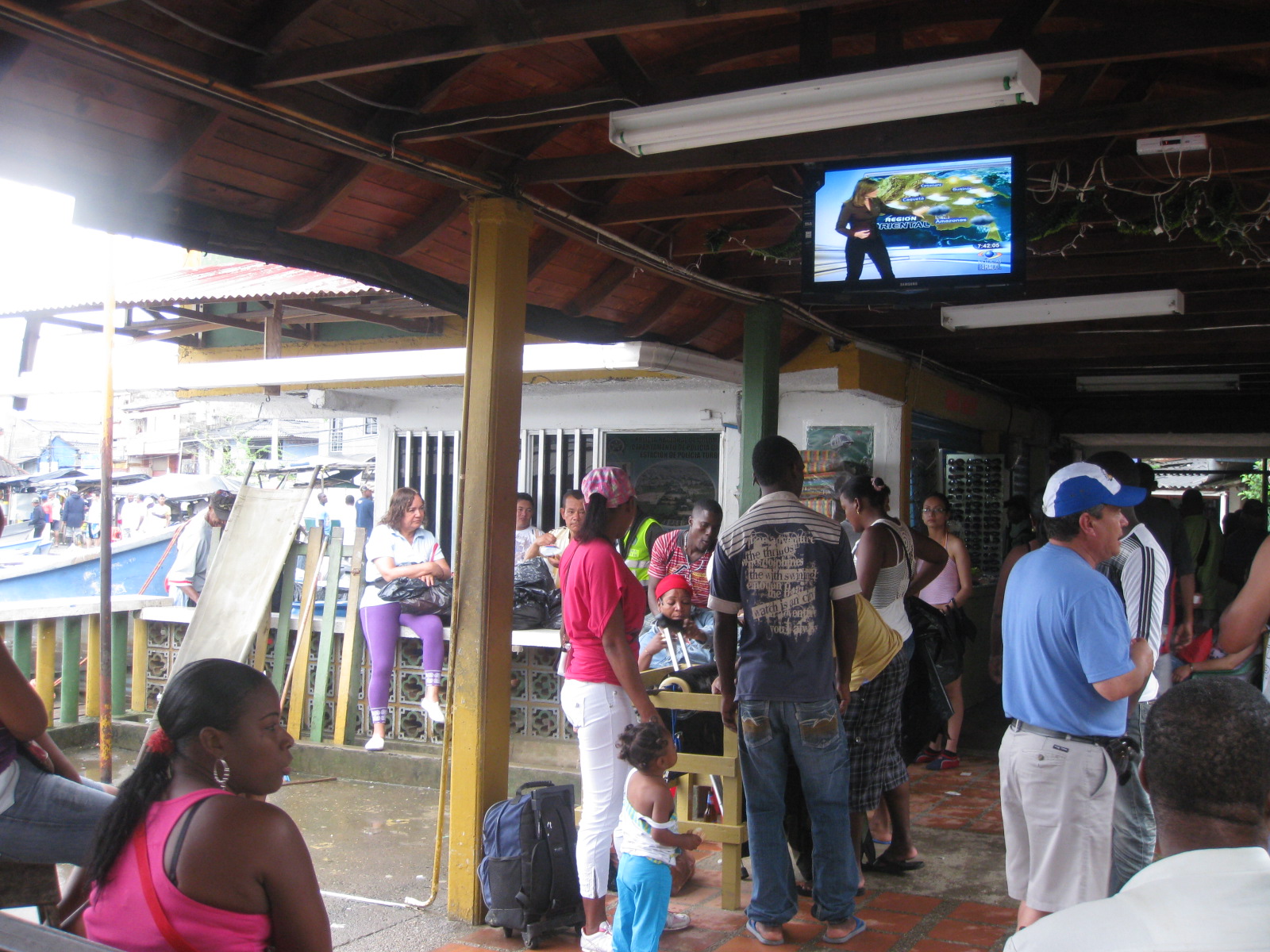
Two hours or so passed until the boat was repaired.  Over a large tv monitor at the terminal the forecast was for another storm incoming and a continuation of the monsoon that had been afflicting Colombia.  For my part, I had seen much rain the previous weeks, lots of landslides, but not anything that I would call drastic as far as storms or flooding. Which, I´m afraid to say, was about to change.

Our panga loaded up and once again we departed that sewer-hole harbor.  I was headed north to the town of Capurgana, which I was told was a nice place to visit.  A small port, it´s one hop north as you´re making your way up the coast and into Panama.  

The first hop involved that over-loaded, over-sized rowboat down in Colombia.  Being one of the last to board I was seated in the front row -- which I knew was a bad spot but what could I do?  It was the only space left.

After about an hour underway we reached wide-open bay -- and open expanses for waves to sweep on in from the stormy Caribbean.  And sweep in they did -- great, gaping walls of green water, crashing in on that scow and giving it, and us, a savage pounding.

The bow was so high in the air, and piled up with luggage, all of it enclosed in black plastic bags to keep dry, that I couldn´t see to prepare myself for the seas piling in and took perhaps the worst of it.  The effect became like a crash dummy in a car hitting a barricade.  I was flung against the sides, the front...My spine was slammed repeatedly down against the seat.  People were crying -- and crying out in pain.  With me being one of them.  It was no longer fun, this traveling thing.  I got seasick, the first time in my life, and spewed over the side time after time.

I shook my fist back at the coxswain (driver) and shot him dirty looks -- all he had to do is cut the throttle, I figured, and slow us a little.  But to no avail.

The violence was so bad that the board forming the back of my seat was ejected skyward from its slots.  I cowered in fetal position on the floor upon life jackets spread out.  Every time a wave slammed us I gave out a pitiful groan as the impact shuddered through me, but at least I wouldn´t blow out a disc in my spine is the way I figured it.

At one point the warm Caribbean gushed over the side...I fingered the straps on my life jacket and wondered what it would be like to have to swim for it.  Soon after, with me laying there in the water and puke, the ride calmed as we made into Capurgana at last.

None of this did I see as I had to helped up out by kind and caring hands and was laid out on the dock to cries of "medico!  medico!"  The ordeal was finally over, or at least that one was, to be followed by another -- taking stock of my injuries.


Pier at Capurgana -- where I was laid out like a slab of meat


At the first, El Delphín (the dolphin) I met Ron from New York City who had been on the same panga.  Yet he was calmly sitting there, finishing stripping a fish bare to the head and skeleton and chewing it up as nice as you please.  Go figure.  He had been seated better and didn´t suffer nearly as much.  There was no room at the inn at El Delpín, it turned out; so my guide/porter shouldered my duffel again and led me onward.

We sloshed to a hostel called La Pesquera where a bunk in the corner of the dorm beckoned and I plopped there...basically for two days.  During which time the rains were so ferocious that the streets ran with water that at one point seeped beneath the doors.  Good god, I thought -- first I get thrashed at sea and now I`m about to get flooded out.

As I laid there those hours, drops flailing the tin roof, I performed a rough assessment of myself:  both knees battered black and blue, my back so sore I ached to get out of bed, muscles painfully strained in my right chest, right side of my head swollen and sore...


Wow, no rain in Capurgana

To top it off, Capurgana was another town populated with castañas and they seemed to have even more boom boxes per capita than in Turbo!  In addition, the hostel and its crowded neighborhood was barking dogs, squalling kids, crowing roosters...Good god, I lamented, first one wretched place and now another.  How I wanted to find that guy who talked me into coming to this coast in the first place. 

As they say though, God provides...For hours two Colombian women sat silently in the dorm weaving jewelry and wristbands on their bunks, and their presence was calming, even healing, amid the din.

In addition, Ron from NYC and I shared dinners and drinks together a few times.  A Canadian by birth, Ron escapes the pressures of Wall St. by traveling through back regions of Colombia, regions often controlled by FARC, an anti-government, guerrilla faction there.  He´s even been captured by FARC and used his wit, and political acumen, to be set free.  These conversations were bordering on therapeutic and meeting him was almost worth that god-awful bashing.

I soon fell in with two fellow trekkers in the dorm -- Santiago from Argentina and Juan Pablo from Italy -- who were soon to be heading up along coast to catch a plane to Panama City.  Pain in my back or no pain in my back, about then that sounded good to me.  After only a few days, I had had enough of that coast altogether.

The only thing was, to get up to the airstrip involved crossing a touchy international border -- as well as another of those boat rides....

TO BE CONTINUED


Beach scenes near Capurgana


Monday, December 13, 2010

Into The Cloud Forest


 Fabien from France and Kelly from South Korea

In many ways it was the same ol´ story.  Yet another natural wonder beckoning, with a long and hazardous trek to explore it.  And me bouncing into town earlier on a bus and half green about the gills from the journey.

By and large the seven-hour ride from Medellin wasn´t too bad; with nice scenery through the coffee country -- green rolling hills shrouded in mist, cut by brown, roiling rivers.  I could at least eat lunch at the break half-way.  A chorizzo or sausage nonetheless.  I was proud of myself.

However, coiled and waiting that last thirty minutes leading up to Salento, my destination, was my old nemesis -- switchbacks and more switchbacks -- which pushed me over the edge. 

Naturally we´re crammed in like frijoles in a can, naturally the driver is a wild man.  And naturally everyone else is gabbing away gaily in Spanish...except me, who´s wishing in the worst way by now that he hadn´t had that chorizzo.

Taking the reigns in front of Tra-la-la
We reach the town square just in time.  I extract myself from the seat, stagger off and look around...

My brain reels.  My duffel is sopping from a leaky baggage compartment.  I don't know anyone.  I don´t know where to eat, even if I could, and most of all I need a place to shower and rest.  You would think that I´d be concerned, wouldn´t you? 

I am not for at least two reasons:  First, I am armed with some knowledge of español, which allows communication with the natives.  And second, I have a card for a good hostel a block off the square.

In this case, it´s called the Tra-la-la, run by a Dutchman named Hemmo with purry black cat.  Hemmo opened just this summer and was recommended by various trekkers days before, back in Medellin.  The place is spotless and trimmed in bright orange, the national color of his native Holland.

Within minutes of stepping off that bus then, I am wheeling my duffel in and plopping onto a bunk with clean sheets.  I have hot showers, maps and information about the area...for about $10 U.S. per night.   More importantly though, I am around other trekkers, some of them who had also come in solo and were also wanting to see the sights.

The path was a muck. Kelly and Sara pick their way.
I´ve done this in many different countries now.  It´s more than just happenstance.  It´s a spontaneous, free wheeling way to travel, and the hostel system, the trekkers´ or backpackers´ trail, makes it possible.

The scenic highlight, the natural wonder in this particular area is a place called Valle de Corcora, a national park in Colombia.  It's a forty-minute ride out of town, followed by the long and muddy trek to get a good look at the place.  It´s over moss-coated boulders, log bridges and steep mountain paths -- not something I wanted to do alone, probably not something that anyone should do alone.
 
Anything I have learned in my travels, never fear at the hostel.  Wait a while and things will start to happen.  Sure enough, within a few days at Tra-la-la had formed an international excursion team, I'll call it.

First up was the amiable Sara from Canada, who had just banged in on buses herself and also wanted to see the valley.  Then came the suave Fabian from France, who was likewise on both counts.  Throw in myself, of course, and presto you have a team.

One fine morning we set off, the three of us, and while bouncing up to the valley in the back of a Jeep, we add Kelly from South Korea.  This was a good thing, it turned out, because she was outfitted better than Hillary making for the summit of Everest and shared everything from hats to umbrellas to packages of vanilla wafers with the rest of us.


 One of several such crossings within the valley

The trek itself was grueling, mucky and good.  About six hours all told.  One of the highlights was ascending the trail to a small-farm-like station high in the rain forest.  That last few hundred meters was a struggle, our lungs and legs burning, through lush vegetation and the air everywhere thick with water droplets.  By now we were actually in the clouds.

Accomplishing this finca at last, we plopped at picnic tables and were greeted by a smiley campesino and his roundish wife, who manned this high outpost.  They served us hot chocolate in bowls and arapas or corn pancakes and cheese.  As we ate and rested, a squadron of hummingbirds, eight or ten, flitted in and out of bowls of sugar water only a few meters away.  I think everyone got decent pics except me.  They move so fast and all.  After about a dozen attempts I gave up.

As for the Valle de Corcora itself, it ranks as one of the most beautiful and enchanting places I´ve ever seen.  Certainly in my top ten.  With the low clouds and swirling mists the hike had a dream-like quality, where breath-taking views were first offered, then taken away.  Followed by long trudges with visibility limited to the likes of hanging mosses and water dripping off of waxy leaves.

Despite the exertion and the mud, the whole thing was truly magical and I shall treasure it, and the people who came along, for a long time.  And it all was made possible because of the hostel trail -- places such as Tra-la-la and the good people who run them.


The team pauses for a few pics


Palmas de Cera


Tuesday, December 7, 2010

Coffee Country, Part II


Two types of beans grown -- Arabica and Colombian

It took a while but I finally tracked him down -- Juan Valdez, that is.  Appropriately enough, he was on a small coffee farm in the misty highlands of central Colombia.  Una finca del café, as they call them here.  And like seemingly everyone else these days, he was waiting out the rain.

"Sie, sie.  Me llama Señor Valdez," he laughed.  Evidently having heard the joke many times before.  In reality his name is Fredy and he´s the administrator of an organic farm outside the town of Salento, in the heart of the coffee country.  One of his jobs is to conduct tours of the place.

I was accompanied by Sara, a trekker from Canada who I hooked up with at the Tra-la-la, a hostel in Salento.  Wearing rubber barn boots, we slid and sloshed about a km. down a muddy trail, to the little operation just outside of town.

Separating the husks from the actual beans
The tour is offered in Spanish one day and English the next.  Our day happened to be in Spanish.  Fortunately Sara speaks it better than I do and she filled in the gaps when I was struggling to understand Fredy's explanations.

More just than an education of coffee production, it was a view of life in the highlands, complete with Collies nuzzling at our knees, pussy cats jumping onto our laps, cups of coffee, about as fresh as you can get, and farmhands offering of marijuana, also about as fresh as you can get.

Despite the fact that I've never been much of a coffee drinker, I found it all fascinating. Especially since, compared to the larger, more commercial operations, this finca had such a down-home atmosphere.  

And the coffee was alright, too.  Sara appreciated it more than I did, being a long-time consumer.  

When first on the tongue, it was on the bitter-ish side, which I´m told is typical of this region.  All in all though, it was satisfying and fulfilling as it worked its way down to my innards.  To really appreciate it, I´d say, you have to first taste and then swallow to get the full effect.

Maybe that's the way all coffee is, I don´t know.  But that was just the raw taste, the physical part.  What I took away from this was much more.  As we clomped back into town I had a new awareness, an enlightenment even -- of  la cultura de café, as they call it here.  The culture of coffee, which is so much of life in Colombia. 

You can see it at the many cafes in Salento -- campesinos, the country folk, sitting around in straw hats and ponchos and wearing barn boots, which seemingly everyone wears here during the rainy season -- sipping the local product and exuding of...well, of something good, I know that much.  

How can I explain?  They're smiling and chatting and nodding buenos dias to everyone who walks in, including wayward trekkers from Pennsylvania.  Kind of a Starbucks where everyone extends a happy face (and there's no wi-fi).

There´s an intangible then, to this las cultura.  An emanation of good will and sociability and camaraderie that I just wanted to go and join in.  Heck, I didn't even drink the coffee in the one place, off the corner of the square in Salento.  I'd sit in there sipping Coke or chocolate just to sit in there and grin along with them.


Speaking of chocolate -- hot chocolate, that is.  The kind maybe you´re drinking back in cold weather country now, with marshmallows on top and all that.  They serve it down here in bowls, soup bowls.  Often you get it as part of breakfast, you know, with eggs, corn bread and such.  You pick up the bowl with both hands and slurp it on down -- seemingly in defiance of the good manners that mother used to teach.  But that´s how Colombianos do it

It´s weaker than the hot chocolate back in the States, watery even, but tasty in its own way nonetheless. 

At any rate, being a farm boy and all that, I tend toward the agriculture-type places on these trips.  I´ve been to coconut plantations in the Philippines, rubber and palm oil plantations in Malaysia, rice noodle factories in Vietnam, banana and mango farms in Indonesia, fish and snake farms in Thailand...and now the fincas in Colombia. 

Of all of these, I have to say, this is the first one where I wish I could take home not just some of the product, but some of what goes along with it.


Sara and Fredy at la finca del café 


Even the streams are coffee-colored here